Skip to home
المدونة

Zalt Blog

Deep Dives into Code & Architecture at Scale

The History of AI in One Timeline

By محمود الزلط
Insights
1h 5m read
<

So who invented AI? Maybe we all did. Human survival drove farming farming needed counting counting birthed math math built machines machines created computers computers generated data data trained AI AI got transformers transformers power AI. Call it the longest relay race in tech, passed hand-to-hand for thousands of years.

/>
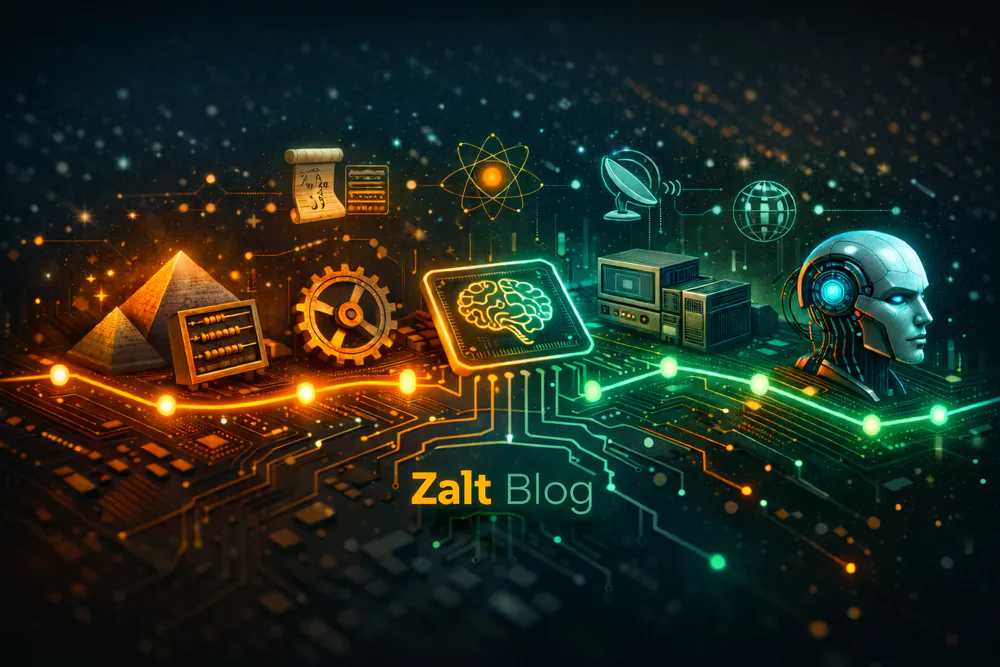
The History of AI in One Timeline - Featured blog post image

Every AI breakthrough traces back to a single moment: when ancient Egyptians first counted their crops. This interactive timeline reveals how that simple act of counting became the foundation of artificial intelligence and how every innovation since has been building toward machines that think.

Scroll through all entries chronologically or filter by domain to trace a single thread: Mechanics, Mathematics, Physics, Electricity, Computing, Communication, Internet, Mobile, AI. Each discovery builds the foundation for what follows.

This isn't just a history lesson, it's a map of how human curiosity became digital reality. Watch how each discovery unlocked the next, creating the building blocks of modern intelligence. But which discovery was the real turning point? The answer might surprise you.

All 145 Events
Only 22 Critical Events
Mathematics
3000 BCE

Egyptians Planted The First Number

by Ancient Egyptians

You're probably reading this on a screen, attached to a device performing billions of calculations every second, powered by flows of electricity and connected to invisible streams of data weaving through the air.

None of it would exist without the need to eat! Around 5,000 years ago, in the process of securing a sustainable food source, ancient Egyptians began searching for ways to count crops, divide harvests, measure fields, and track the seasons.

Survival pushed humans to create order, and from that order came mathematics, the first true language of logic. Every algorithm, computer, and AI model today is built on its timeless foundation.
1
Mathematics
2000 BCE

Babylonians Found The Missing Numbers

by Ancient Babylonians

After a thousand years, numbers began to feel too simple for the questions people were asking. What happens when you know part of a problem but not the rest? How do you calculate what you can't see?

The Babylonians faced these questions as they tracked trade, built cities, and mapped the stars. They inherited the idea of numbers from earlier civilizations and took it further—creating algebra, a way to find unknown values through patterns and equations.

That way of thinking never disappeared. The Babylonians weren't just solving equations—they were teaching future minds how to reason through uncertainty. Thousands of years later, AI would inherit that same habit: finding patterns in what's known to uncover what isn't.
2
Electricity
600 BCE

Thales Discovered The Spark

by Thales of Miletus

After centuries of measuring, trading, and building, human curiosity turned toward the unseen. In ancient Greece, Thales of Miletus noticed that when amber was rubbed with fur, it could attract small bits of straw and dust. For the first time, people saw that invisible forces could move matter itself.

It seemed like magic, but it was the birth of a new idea—energy could exist beyond what the eye could see. That spark of wonder began humanity's long journey into understanding electricity, a force that would one day power cities, machines, and even the intelligence inside your screen.

That first spark did more than move bits of straw—it lit a path. Humanity had discovered that invisible forces could shape the physical world, the same realization that powers every circuit, computer, and system behind today's AI.
3
Mathematics
500 BCE

Pythagoras Measures the Invisible

by Pythagoras

After Thales revealed that unseen forces could move matter, another question arose: could the invisible be measured too? For the first time, humans began to suspect that harmony and form obeyed hidden laws, waiting to be written in numbers.

Pythagoras found one—the rule binding the sides of a right triangle, simple yet eternal. With it, geometry became a language of balance and truth. Builders shaped temples with perfect symmetry, astronomers mapped the heavens, and thinkers saw that reality could be described by proportion.

That way of thinking never vanished. The same geometric rhythm now guides computer vision, 3D modeling, and the spatial reasoning that helps AI make sense of the world it sees.
4
Mathematics
300 BCE

Euclid Writes the First Algorithm

by Euclid of Alexandria

In Alexandria's quiet classrooms, Euclid searched for order inside the noise of numbers. He asked: how can you always find what divides two numbers evenly, no matter their size? It was a question of logic, not luck.

His answer became the Euclidean algorithm—a sequence of steps that always reached truth through repetition. For the first time, reasoning could be written down and followed like a trail, exact and reliable.

That small act of precision changed everything. It was the moment thought became process. Every computer program and AI model today still follows that same idea: intelligence as a rhythm of clear, repeatable steps.
5
Computing
200 BCE

The Greeks Build the First Machine Mind

by Ancient Greek Engineers

In a workshop near the Aegean, Greek engineers faced a cosmic puzzle—how to follow the wandering stars without human hands calculating every turn. They turned to metal, to gears and wheels, hoping to make the heavens move themselves.

Their creation—the Antikythera Mechanism—was a bronze sky in a box, a clockwork universe that could predict eclipses and chart celestial cycles. It was mechanical thought made visible, a mind of ratios and rotations.

Hidden in those gears was a quiet prophecy: that logic could live outside flesh. Two millennia later, every processor and predictive algorithm still hums with that same ambition—machines that calculate, foresee, and think in motion.
6
Mathematics
120 BCE

Hipparchus Maps the Heavens in Numbers

by Hipparchus

After centuries of watching stars trace silent paths across the night sky, Hipparchus asked a new kind of question: how can angles and distances be measured, not just imagined? The heavens, he believed, could be mapped by reason as surely as by sight.

He created trigonometry—the art of relating the sides and angles of triangles. With it, sailors could find their course by starlight, and astronomers could chart the skies with precision. It was geometry set in motion, numbers made to turn and tilt.

That quiet discipline never faded. The same principles now let computers render worlds, rotate images, and teach AI how to see depth and form—the same math, only faster than the stars once moved.
7
Mechanics
100 BCE

Gears Create the First Machine Logic

by Ancient Greek Engineers

In the workshop where the Antikythera Mechanism was born, Greek engineers discovered something profound—that circular motion could be transformed, redirected, and controlled through interlocking teeth.

Gears became the first mechanical logic gates, where the rotation of one wheel could drive another at different speeds, reverse direction, or multiply force. It was computation made physical.

That mechanical logic never stopped evolving. From ancient clockwork to modern transmissions and robotics, gears remain the fundamental language through which machines think, calculate, and move—the mechanical foundation of every automated system today.
8
Mathematics
1000

Al-Khwarizmi Teaches Logic to Count

by Muhammad ibn Musa al-Khwarizmi

Long after Euclid's careful steps, a scholar in the House of Wisdom in Baghdad faced a different kind of chaos—the flood of numbers from trade, astronomy, and engineering. Muhammad ibn Musa al-Khwarizmi asked: how can we make calculation itself obey rules?

He answered with algorithms—systematic, step-by-step methods that could solve any arithmetic or algebraic problem. To him, computation was not guessing but procedure, a structure anyone could follow toward truth.

That rhythm of ordered thought became the pulse of every program that came after. From his ink-stained tables to the circuits of modern processors, the logic he tamed still powers the reasoning inside AI.
9
Mechanics
1300

Clockwork Brings Time to Life

by Medieval Monks

In medieval monasteries, monks needed to track time precisely for prayers and work. Their solution was mechanical—weights, gears, and escapements that could count the hours without human intervention.

The mechanical clock became humanity's first autonomous machine, operating continuously without human guidance. It was automation in its purest form—a system that could maintain itself and perform its function indefinitely.

That principle of autonomous operation never stopped ticking. From medieval clocks to modern robotics and AI systems, the idea of machines that can operate independently traces directly back to those first mechanical timekeepers.
10
Mathematics
1545

Cardano and the Birth of the Impossible Number

by Gerolamo Cardano

By the Renaissance, mathematics had grown bold. Yet some equations refused to yield—problems whose roots seemed to vanish into nothing. Gerolamo Cardano refused to accept the void. He imagined a new kind of number, one that combined the real and the unreal.

These 'imaginary' numbers could not be seen, but they worked. They described oscillation, rotation, and rhythm—the hidden patterns behind sound, light, and motion. What was once forbidden became a new dimension of thought.

Today those same complex numbers hum through every signal, waveform, and neural network. The imaginary turned indispensable—the language through which AI hears, sees, and processes the world's constant vibration.
11
Electricity
1600

Gilbert Gives Electricity Its Name

by William Gilbert

After centuries of awe toward lightning and lodestones, William Gilbert sought to replace superstition with measurement. As Queen Elizabeth's physician, he spent long nights studying how amber, metal, and magnet pulled and turned when touched by hand and spark.

He called the strange force *electricus*—a word that brought mystery into language and made it real. For the first time, magnetism and electricity became subjects of study, not whispers of magic.

That act of naming lit a quiet fuse. From Gilbert's compass needles to the circuits guiding modern AI, every charged idea begins the same way—with the decision to study what once seemed divine.
12
Mathematics
1614

Napier Turns Numbers into Motion

by John Napier

In an age before machines, John Napier faced the weary work of human calculators—astronomers, navigators, and merchants drowning in endless multiplication. He wondered: could numbers be made to move more easily, like gears?

His answer was logarithms—tables that turned multiplication into addition, division into subtraction. With them, complex calculations collapsed into simple steps. The universe suddenly felt more computable.

That change of scale never ended. From Napier's tables to algorithms and processors, the dream remains the same: make thought faster by transforming effort into pattern.
13
Computing
1623

Schickard Builds the Clock That Counts

by Wilhelm Schickard

As numbers grew too large for the mind alone, Wilhelm Schickard asked a daring question: could wood and metal carry the burden of arithmetic? In his workshop he built the Calculating Clock—a machine of gears that could add and subtract without human hands.

It was quiet but radical: the first glimpse of automation in mathematics. A device that could *think* in numbers by turning them.

That same spirit drives every processor today. From Schickard's spinning wheels to silicon chips, the goal is unchanged—to make thought mechanical, and let the machine remember the count.
14
Computing
1642

Pascal Makes the Machine Useful

by Blaise Pascal

Blaise Pascal, just nineteen, watched his father lost in columns of taxes and sums. He wondered if a device could shoulder that monotony. Out of brass and patience, he built the Pascaline—the first calculator built not for wonder, but for work.

It clicked and spun, carrying numbers across tiny gears. What began as filial duty became proof that computation could serve life outside academia.

That practicality endured. Every spreadsheet, every embedded chip, still echoes Pascal's intent—to make machines not curiosities, but companions in labor.
15
Mathematics
1654

Pascal Discovers the Mathematics of Probability

by Blaise Pascal & Pierre de Fermat

Fortune tables and dice filled the salons of France, but for Blaise Pascal and Pierre de Fermat, chance was more than play. They asked: can luck itself be counted?

Through letters between them, probability was born—the mathematics of uncertainty. For the first time, randomness had rules, and risk could be reasoned with.

Centuries later, that same logic guides machines that learn from data, weighing odds and outcomes with cold precision. What began as a game of chance became the language of prediction that fuels modern AI.
16
Mathematics
1665

Newton Invents the Mathematics of Motion

by Isaac Newton & Gottfried Leibniz

Nature was full of motion—falling apples, orbiting moons, rushing rivers—and yet no one knew how to measure change itself. Isaac Newton and Gottfried Leibniz, working worlds apart, both asked the same question: how can movement and growth be calculated, not just observed?

Their answer was calculus, a language for change. It could capture acceleration, curve, and flow—turning motion into mathematics. Suddenly, the universe could be traced by numbers.

That insight became the silent engine of optimization. Every AI model trained, every function minimized, every gradient followed—still whispers the logic they discovered: that learning is just change, measured precisely.
17
Computing
1671

Leibniz and the Dream of Complete Calculation

by Gottfried Leibniz

Gottfried Leibniz looked at Pascal's simple adder and saw a greater promise: a machine that could perform every arithmetic act known to man. He imagined thought itself rendered in wheels and levers.

The result was the Stepped Reckoner—a device that could add, subtract, multiply, and divide automatically. A small box, but a vast idea: that any operation could be reduced to precise, repeatable motion.

That dream still hums inside every processor. From clattering gears to silent circuits, the lineage is clear—logic seeking perfection through mechanism.
18
Mathematics
1679

Leibniz Discovers the Language of Machines

by Gottfried Leibniz

After conquering arithmetic, Leibniz asked a question that sounded simple but wasn't: how few symbols do you need to describe everything? He saw beauty in reduction—the idea that the infinite could be written with almost nothing at all.

His answer was the binary system: numbers built only from 0 and 1. To him, it mirrored creation itself—something from nothing, unity from void. Two symbols, infinite combinations.

Centuries later, that same simplicity became the soul of computing. Every bit, every digital pulse, every AI thought lives in that stark duality—on or off, yes or no, the logic of the world rewritten in two beats.
19
Physics
1687

Newton's Laws Define the Rules of Motion

by Isaac Newton

In Cambridge, Isaac Newton watched an apple fall and asked: what force makes everything move? His answer became the three laws of motion—the fundamental rules that govern all mechanical systems.

For the first time, motion could be predicted, calculated, and controlled. Every object's behavior could be understood through mathematical relationships between force, mass, and acceleration.

That mathematical foundation never stopped evolving. From Newton's laws to modern robotics and AI systems, the principle of predictable motion became the foundation of every mechanical system that moves, calculates, and operates in the physical world.
20
Mathematics
1736

Euler Draws the First Map of Connection

by Leonhard Euler

A riddle of bridges haunted the city of Königsberg: could one walk across all seven without repeating a step? Leonhard Euler turned the problem sideways and asked a deeper question—what if you ignored distance and focused on connection?

His solution became graph theory: a way to represent relationships as points and lines. With it, he built a mathematics not of shapes, but of links.

That idea became the quiet architecture of the digital world. From social networks to neural ones, from routers to relationships, every system that connects owes a trace to Euler's bridges.
21
Electricity
1752

Franklin Brings Lightning to Earth

by Benjamin Franklin

Beneath a storm-dark sky, Benjamin Franklin stood with a kite and a key, chasing the spark that split heaven and ground. He wanted to know if lightning and the shocks of amber were the same unseen force.

When the key hissed with charge, myth gave way to science—electricity was nature itself, not wrath or miracle. The sky had laws, and they could be known.

From that spark came every wire and circuit that followed. The power that once terrified humanity now hums through every chip that helps machines think.
22
Electricity
1800

Electricity Becomes Usable

by Alessandro Volta

Benjamin Franklin had proven what electricity was. Alessandro Volta asked what it could become. He wanted not just flashes, but flow—power steady enough to use.

He stacked copper and zinc with brine-soaked cloth, and the voltaic pile was born: the first battery, a device that stored potential and released it as current. For the first time, energy could be summoned, not waited for.

That invention lit the age of circuits. Every modern processor, every AI running on portable power, still traces its pulse back to Volta's quiet tower of discs.
23
Mathematics
1801

Gauss Computes the Orbit of Ceres

by Carl Friedrich Gauss

When the asteroid Ceres disappeared behind the sun, astronomers feared it was lost forever. Carl Friedrich Gauss faced an impossible task: predict where it would reappear using only a few scattered observations. He needed to find the best fit—the orbit that minimized error across all measurements.

His solution was the method of least squares, a way to find the optimal answer when data is noisy and incomplete. By minimizing the sum of squared errors, he could extract truth from uncertainty. When Ceres emerged exactly where Gauss predicted, mathematics had proven it could find patterns in chaos.

That principle of optimization never faded. Every machine learning algorithm, every neural network that adjusts its weights, every AI that learns from imperfect data, still follows Gauss's insight: intelligence is finding the best fit between what you know and what you seek.
24
Mathematics
1805

Legendre Publishes the Method of Least Squares

by Adrien-Marie Legendre

Gauss had used least squares to find Ceres, but kept the method private. Adrien-Marie Legendre saw the need for a general tool—a way to extract truth from any set of noisy measurements. In 1805, he published the method of least squares, making optimization available to all.

His approach was elegant: find the curve that minimizes the sum of squared differences between observations and predictions. What worked for orbits could work for any problem where data spoke with uncertainty.

That publication democratized optimization. From astronomers to engineers, from statisticians to AI researchers, every field that seeks the best fit from imperfect data still follows Legendre's published method—the mathematics of finding truth in noise.
25
Electricity
1820

Ampère Finds the Invisible Thread

by André-Marie Ampère

Alessandro Volta had taught the world how to store electricity. André-Marie Ampère wanted to see what it could do. When he passed current through a wire beside a compass, the needle twitched. Electricity, it turned out, could move magnetism.

That single turn of a compass birthed electromagnetism—the union of two invisible forces once thought separate. Energy could now push and pull, twist and turn.

From that discovery came every motor, speaker, and hard drive—and eventually, the precise magnetic pulses that help AI store and recall its digital memory.
26
Electricity
1827

Ohm Teaches Electricity to Speak in Ratios

by Georg Ohm

Electricity was still wild—beautiful, unpredictable, and poorly understood. Georg Ohm spent years wiring, measuring, and watching how current changed as it flowed through metal. He began to see a pattern: voltage, current, and resistance always danced in proportion.

He captured their relationship in one simple equation: V = I × R. The mystery became math.

That law turned chaos into design. Every circuit, from a light bulb to a neural chip, still hums by Ohm’s rule—where resistance meets current in perfect balance.
27
Electricity
1831

Faraday Spins Motion into Light

by Michael Faraday & Joseph Henry

Michael Faraday and Joseph Henry, working oceans apart, both wondered if motion itself could make electricity. When Faraday moved a wire through a magnetic field, a spark jumped—mechanical movement had created electric current.

This was electromagnetic induction: motion becoming electricity, electricity becoming motion. A perfect loop of energy.

From this principle came generators, motors, and the entire power grid—every source of current that feeds today’s machines, from city lights to data centers teaching AI to think.
28
Computing
1834

Babbage Dreams of a Thinking Machine

by Charles Babbage

Charles Babbage looked at the ledgers and tables of his time—full of human error—and imagined a new kind of precision. What if a machine could follow instructions, step by step, never tiring, never wrong?

He called it the Analytical Engine: gears for logic, cranks for memory, and punched cards for input. A device that could, in theory, compute anything describable by rules.

It was never finished, but the idea survived him. Babbage’s blueprint became the ancestor of every computer—and the first whisper that machines could one day reason.
29
Communication
1837

Morse Sends Thought Through Wire

by Samuel Morse & Alfred Vail

The world still moved at the speed of hoof and sail when Samuel Morse and Alfred Vail asked a radical question: can information travel faster than its messenger? They reduced all words to rhythm—short and long bursts of current, dots and dashes across a line.

Morse code was born: the first digital language, built from two states—on and off. Distance folded; silence began to carry meaning.

That binary pulse became the heartbeat of every future network, from telegraphs to the internet, to the electric whispers between AI systems today.
30
Physics
1842

Light Learns to Follow Its Path

by Daniel Colladon & Jacques Babinet

Daniel Colladon and Jacques Babinet were studying the behavior of light when they made a remarkable discovery—light could be guided along curved paths through streams of water using total internal reflection. When light hit the boundary between water and air at the right angle, it bounced back into the water instead of escaping.

This was pure physics—the fundamental principle that light could be trapped and directed through transparent materials. It seemed like a curiosity, but it contained the seed of something revolutionary.

That discovery became the foundation of fiber optics. Every fiber optic cable today still relies on the same principle Colladon and Babinet first observed—light following its own reflection, trapped in glass.
31
Mathematics
1843

Hamilton Maps the Space of Thought

by William Rowan Hamilton

William Rowan Hamilton wandered the Royal Canal in Dublin, obsessed with extending arithmetic into higher dimensions. One afternoon, the insight struck—numbers could move in space if given new rules. He carved the formula for quaternions into a bridge stone on the spot.

With that, linear algebra took shape—a system for manipulating vectors, rotations, and multidimensional relationships. Equations could now describe motion, light, and position all at once.

Those same operations power the neural networks of today. Every rotation in 3D graphics, every transformation in AI models, still follows Hamilton's marks on that bridge.
32
Mathematics
1847

Cauchy: Gradient Descent

by Augustin-Louis Cauchy

Augustin-Louis Cauchy faced a fundamental problem in mathematics—how to find the minimum of a function when you don't know its shape. He described a method that would become known as gradient descent: start at any point, measure the slope, and move in the direction of steepest descent.

It was a simple idea—follow the gradient downward until you reach the bottom. But that simplicity hid profound power. For the first time, optimization became algorithmic, a process that could find the best solution through iteration.

That method became the heartbeat of machine learning. Every neural network that trains, every AI that learns, still follows Cauchy's gradient—descending through error, step by step, toward understanding.
33
Mathematics
1854

Boole Turns Logic Into Algebra

by George Boole

In an age of ink and intuition, George Boole set out to capture reasoning itself in symbols. He stripped thought to its bones—true or false, yes or no—and built a new kind of algebra where logic could be calculated.

His equations didn't describe nature; they described decision. Circuits of thought, long before electricity found them.

That quiet abstraction became the binary heartbeat of every computer. Each flicker of 1 and 0 today is Boole's language, still whispering logic through the wires.
34
Mathematics
1858

Cayley Teaches Numbers to Work in Teams

by Arthur Cayley

Arthur Cayley saw beyond single numbers. He wondered what would happen if they could stand in formation—rows and columns acting as one. He called them matrices, grids of numbers that moved together like choirs instead of soloists.

With them, equations could scale. Problems once unsolvable could now be rotated, transformed, and expanded through orderly arrays.

That collective logic became the heartbeat of modern AI. Neural networks, image recognition, 3D worlds—all are just matrices in motion, echoing Cayley's realization that intelligence is often found in the pattern, not the part.
35
Electricity
1866

Leclanché Makes Power Portable

by Georges Leclanché

Electricity was powerful, but trapped—tethered to wires and wet batteries. Georges Leclanché wanted freedom. By sealing zinc, carbon, and electrolyte paste into a small vessel, he created the first dry cell: electricity you could carry.

It was simple, stable, and portable—a quiet revolution. Power could finally move with people, not just to them.

Every phone, sensor, and autonomous device owes its life to that leap. Leclanché’s dry cell made energy personal, and set machines free from the socket.
36
Electricity
1873

Light Joins the Equation

by James Clerk Maxwell

James Clerk Maxwell saw what others missed—the same invisible force ran through lightning, magnets, and light itself. His equations united them, weaving electricity, magnetism, and light into one elegant field.

He published them quietly, pages of mathematics that read like prophecy. They showed that waves of energy could travel through the empty air.

That unification became the blueprint for every wireless signal to come. Each transmission today, from Wi-Fi to radio, still rides on Maxwell’s invisible sea.
37
Computing
1873

Fingers Find Their Home

by Christopher Sholes

Christopher Sholes watched typists struggle with early keyboards—keys jammed when fingers moved too fast, forcing awkward pauses. He rearranged the layout deliberately, placing common letter pairs apart to prevent mechanical collisions. The result looked strange: QWERTY across the top row.

It wasn't designed for speed—it was designed to survive the rhythm of human hands working with temperamental metal. The compromise worked.

That accidental arrangement outlasted the machines it was built for. From typewriters to smartphones, billions of fingers still dance across Sholes' layout—a Victorian solution frozen in glass and silicon.
38
Mathematics
1874

Cantor Organizes the Infinite

by Georg Cantor

Georg Cantor stared into the nature of infinity itself, searching for structure in the boundless. He realized that even infinite sets could be compared, ordered, and reasoned with.

His creation—set theory—offered mathematics a language of organization. Collections could be defined, grouped, and manipulated logically, no matter their size.

That clarity lives inside every database and programming language today. Whenever AI sorts data, filters results, or builds relationships, it’s tracing the quiet order Cantor found in infinity.
39
Communication
1876

The Human Voice Travels

by Alexander Graham Bell

For centuries, sound had stopped at the limits of air. Alexander Graham Bell wondered if it could travel farther—through wire instead of wind. In a small lab, he spoke, and across the room, a voice answered back through metal and current.

The telephone turned communication from code into conversation. Words gained breath, distance lost its silence.

That experiment bridged the human and the electrical. Every call, every audio signal since, still carries that first trembling echo of Bell’s voice.
40
Electricity
1882

Edison Turns Light into Industry

by Thomas Edison

Electricity had flickered in labs and workshops, but Thomas Edison wanted more than invention—he wanted illumination for all. In the crowded streets of Manhattan, he built the Pearl Street Station: the first power plant to feed homes and businesses through a network of wires.

For the first time, light could be bought, sold, and shared. Electricity became not a marvel, but a service. The city glowed with the promise of progress.

That moment marked the birth of infrastructure thinking—the idea that power, like knowledge, could scale. Every digital network, every cloud of computation, still follows Edison’s blueprint: energy made public, intelligence made possible.
41
Communication
1887

Waves Leave the Wires

by Heinrich Hertz

In a small lab, Heinrich Hertz built sparks and mirrors to chase an idea from Maxwell’s pages. When his detector crackled, theory became reality—waves truly leapt across space.

He could not yet imagine voices or data riding those ripples, but the principle was alive: communication without connection.

Every broadcast since, every signal that skips across oceans, begins with that moment of invisible proof.
42
Electricity
1888

Tesla Sends Power Across the Horizon

by Nikola Tesla

Thomas Edison had made electricity practical, but Nikola Tesla saw its limits. Direct current faded over distance. He imagined a rhythm—alternating current—that could carry energy farther than the eye could see.

In coils of copper and bursts of light, Tesla proved that current could reverse direction in perfect tempo, transmitting power across cities without loss. The world’s hum changed pitch.

That oscillation still drives every grid and circuit. From power lines to processors, AC is the unseen heartbeat that keeps today’s machines—and their artificial minds—alive.
43
Computing
1890

Data Finds Its Voice in Holes

by Herman Hollerith

The 1880 US census had taken eight years to process by hand—tally sheets, ink, and exhaustion. Herman Hollerith saw the crisis coming: by 1890, the population had grown so much that the next census might never finish. He invented a solution: punched cards read by electric sensors, each hole a fact, each pattern a person.

His tabulating machines processed in hours what once took years. Data became machine-readable for the first time—not for control, but for information itself.

That breakthrough built an industry. Hollerith's company became IBM, and punched cards remained the standard way to feed data into computers for seventy years. Every database, every record system, every AI training set still echoes that first grid of possibilities punched in cardstock.
44
Communication
1895

Marconi Teaches the Air to Speak

by Guglielmo Marconi, John Ambrose Fleming & Lee De Forest

For centuries, messages crawled across oceans by ship and wire. Guglielmo Marconi looked to the invisible and asked: could air itself carry a message? Building on Hertz's radio waves, he sent the first wireless signals across open space.

Each pulse leapt from transmitter to receiver, no wires in between—just air and possibility. Soon after, Fleming and De Forest amplified those whispers with tubes of glass and current.

That invisible language became the voice of the world. From radio to Wi-Fi, and the constant chatter of connected devices, Marconi's spark still lives in every unseen signal machines use to speak.
45
Computing
1897

Braun Paints with Electrons

by Karl Ferdinand Braun

Electricity could now move and speak—but Karl Ferdinand Braun wanted it to be seen. He built a glass tube, emptied it of air, and sent a beam of electrons racing toward a coated screen. Wherever they struck, light bloomed.

The cathode ray tube turned current into image. It became the eye of oscilloscopes, televisions, and early computers—electric signals made visible.

That same lineage runs through every pixel today. From phosphor glow to liquid crystal, from CRTs to OLEDs, Braun’s light still dances in the screens where modern intelligence appears.
46
Physics
1900

Planck Discovers the Quantum World

by Max Planck

Max Planck faced a problem that classical physics couldn't solve—how to explain the spectrum of light emitted by hot objects. His solution was revolutionary: energy comes in discrete packets called quanta.

For the first time, physicists realized that energy wasn't continuous but came in tiny, indivisible units. It was the birth of quantum mechanics—the physics of the very small.

That quantum understanding never stopped evolving. From Planck's quanta to modern transistors, lasers, and quantum computers, the principle of discrete energy levels became the foundation of every electronic device that powers modern technology.
47
Communication
1901

Marconi Crosses the Ocean with a Signal

by Guglielmo Marconi

The Atlantic once divided worlds. Marconi wanted to erase it. On a cold December morning, he sent a single Morse code 'S' from England to Newfoundland—and heard it return across the void.

It was the first message to travel an ocean without ship or cable, proof that the planet itself could be wrapped in invisible lines of connection.

That faint signal was the dawn of global communication. Every satellite ping and wireless transmission that binds today’s intelligent systems together still echoes Marconi’s three simple dots.
48
Physics
1905

Einstein Explains the Photoelectric Effect

by Albert Einstein

Albert Einstein studied how light could knock electrons out of metal and realized that light itself must be made of particles—photons. His explanation of the photoelectric effect proved light's dual nature.

For the first time, physicists understood that light could behave as both wave and particle, depending on how it was observed. It was quantum mechanics made practical, light made quantum.

That understanding of light's particle nature never stopped evolving. From Einstein's photons to modern solar cells, cameras, and optical sensors, the principle of light-matter interaction became the foundation of every light-based technology that powers modern electronics and AI systems.
49
Computing
1906

Glass Bottles That Think

by Lee De Forest

Electricity could flow, but it couldn't think—not yet. Lee De Forest added a third element to a vacuum tube, creating the Audion: a glass bottle that could amplify weak signals and switch them on and off. It was the first electronic valve, the first device that could control electrons with precision.

That fragile tube of glass and filament became the beating heart of electronic computing. From radio amplifiers to ENIAC's 18,000 vacuum tubes, they made the first electronic computers possible—machines that calculated with light-speed electrons instead of slow mechanical gears.

Though transistors would replace them, vacuum tubes opened the electronic age. Every computer before 1950, every early calculation of artillery tables and atomic reactions, ran on the glow of De Forest's glass minds.
50
Mathematics
1936

Church Writes the Logic of Thought

by Alonzo Church

Mathematics had long been about numbers, but Alonzo Church wanted to describe reasoning itself. He built a system where every computation could be expressed as a function, every idea reducible to form.

He called it lambda calculus—pure logic dressed as mathematics. It showed that thought could be symbolized, structured, and executed by rule.

That abstraction became the seed of programming. Whenever a machine runs a function, or an AI model maps inputs to outputs, it’s speaking in the quiet syntax Church imagined.
51
Computing
1937

Turing Builds a Mind from Rules

by Alan Turing

Alan Turing looked at mathematics and saw machinery waiting inside. He asked what it meant for something to be computable—and imagined a device that could follow any sequence of logical steps, given time and tape.

His Turing Machine was simple: a strip of symbols, a set of instructions, and a head that moved back and forth, reading and writing. Yet within it lay the entire architecture of modern thought.

Every program, every CPU, every AI simulation still walks the same line—data, rule, result—the mechanical poetry Turing first wrote in his mind.
52
Communication
1941

War Teaches the Air to Speak

by Various (Britain H2S, U.S. SCR-584)

In wartime laboratories, engineers bent invisible waves to new purposes. They learned to send and detect signals using microwaves—high-frequency ripples of energy once thought useless.

What began as radar soon became communication. Data leapt through the air faster and cleaner than ever before.

Those same frequencies now carry everything from satellite calls to Wi-Fi. Out of conflict came connection—the air itself turned messenger.
53
Computing
1942

Turing Breaks the Unbreakable Code

by Alan Turing

During World War II, Nazi Germany encrypted military communications with the Enigma machine—a device with billions of possible combinations that changed daily. Breaking it manually was impossible. Alan Turing designed the Bombe, an electromechanical machine that could test thousands of cipher combinations per second.

It exploited patterns in German messages—known phrases that appeared predictably. The Bombe didn't just calculate; it reasoned through possibilities, narrowing the search until the code cracked.

That breakthrough shortened the war and saved countless lives. More importantly, it proved machines could solve problems too complex for human minds alone—a foundational idea for artificial intelligence.
54
AI
1943

McCulloch Imagines the Electric Brain

by Warren McCulloch & Walter Pitts

Alan Turing had shown that machines could think in logic. Warren McCulloch and Walter Pitts wondered if they could think in neurons. In their paper 'A Logical Calculus of the Ideas Immanent in Nervous Activity,' they built a mathematical model of the brain—each neuron firing or resting, 1 or 0, connected in networks of simple decisions.

Their artificial neuron could perform logic, learn patterns, and combine to form complex behavior. The mind, it seemed, could be computed.

That spark became the first neuron of artificial intelligence. Every neural network today—every AI vision, voice, and thought—still echoes the binary rhythm they discovered: signal, silence, understanding.
55
Computing
1945

Von Neumann Draws the Map of the Machine

by John von Neumann

After the war, rooms filled with wires and switches had proven that machines could calculate—but not yet think. John von Neumann saw the chaos and asked: what if computation had structure?

He proposed a model with memory, a processing unit, and a way to store instructions alongside data—the architecture every computer would follow. Programs could now direct machines to do anything logic allowed.

That separation of brain and memory became the silent skeleton of all computing. Every phone, server, and AI still moves along von Neumann’s blueprint: fetch, decode, execute, repeat.
56
Computing
1947

The Transistor Shrinks the World

by John Bardeen, Walter Brattain & William Shockley

Vacuum tubes once filled rooms with heat and hum. At Bell Labs, John Bardeen, Walter Brattain, and William Shockley discovered that a small piece of semiconductor could amplify electrical signals without the bulk and fragility of glass chambers.

Their transistor was small, cool, and precise—a spark of control in crystalline germanium. For the first time, electronic devices could be made tiny, efficient, and reliable.

That discovery became the seed of the digital age. Every chip, every neural processor, every whisper of artificial thought still runs through the transistor's tiny pulse—billions of them smaller than a virus, all descendants of that first fingertip-sized switch.
57
Communication
1947

Cells That Connect the World

by Douglas H. Ring & W. Rae Young (Bell Labs)

Douglas H. Ring and W. Rae Young at Bell Labs looked at mobile communication's biggest problem: too many people, too few frequencies. Their radical idea was to divide territory into hexagonal 'cells,' each with its own transmitter reusing the same frequencies that neighbors used—just far enough apart to avoid interference.

One cell could hand off a call to the next as someone moved, creating seamless coverage without needing unique frequencies for every conversation.

That cellular concept made modern mobile phones possible. Every call, every data packet traveling through 4G and 5G networks today still moves through Ring and Young's invisible honeycomb, quietly keeping billions connected.
58
AI
1950

Shannon Builds a Mouse That Remembers

by Claude Shannon

Claude Shannon watched machines calculate, but wondered if they could learn. In his lab at Bell Labs, he built Theseus—a mechanical mouse that could navigate a maze, remember its path, and find the shortest route through trial and error.

Theseus wasn't just following instructions—it was adapting. Each wrong turn taught it something, and it stored that knowledge in relays and switches. When placed in a new maze, it explored, learned, and optimized its route. For the first time, a machine demonstrated the ability to improve through experience.

That small electromechanical mouse became a quiet prophecy. Every reinforcement learning algorithm, every system that learns from mistakes, still echoes Shannon's insight: intelligence isn't just calculation—it's the ability to remember what didn't work and try something new.
59
AI
1950

Turing Asks the Unaskable

by Alan Turing

By mid-century, machines could calculate, but could they *think*? Alan Turing reframed the question—not as philosophy, but as experiment. If a machine could converse so convincingly that a human couldn't tell the difference, would it matter whether it 'thought' or merely imitated?

His proposal, the Turing Test, turned speculation into science. Intelligence, he suggested, might simply be behavior convincing enough to pass for mind.

That question still lingers beneath every algorithm. Whether large language model or simple chatbot, all still echo Turing's quiet dare: convince me you understand.
60
Computing
1951

Computing Finds Its Market

by UNIVAC (Eckert-Mauchly Computer Corporation)

Until the 1950s, computers were colossal and confined to labs. UNIVAC changed that. Built for business, it could process census data, payroll, and predictions—all at once.

For the first time, computation left the research hall and entered the workplace. It wasn't just calculation anymore; it was commerce.

That shift made data a tool of trade. Every corporate server and cloud cluster still follows UNIVAC's example—machines not as experiments, but as partners in enterprise.
61
AI
1952

A Machine Teaches Itself

by Arthur Samuel

Arthur Samuel faced a challenge—could a computer improve at a task without being explicitly programmed for every scenario? He built a checkers program that played against itself, learning from victories and defeats.

With each game, it adjusted its strategy, recognizing patterns that led to wins. Eventually, it played better than Samuel himself. The machine had learned, not from instructions, but from experience.

That breakthrough gave birth to a term Samuel coined: 'machine learning.' Every AI that improves through data today—from recommendation engines to self-driving cars—traces back to those silent games of checkers.
62
Mechanics
1952

CNC Machines Bring Digital Control

by MIT Engineers

In MIT's laboratories, engineers faced a problem: how to make machines follow precise instructions without human error? Their solution was numerical control—programming machines with numbers instead of physical templates.

Computer Numerical Control (CNC) became humanity's first digital manufacturing system, where machines could follow complex instructions with perfect precision. It was programming made physical, software controlling hardware.

That principle of digital control never stopped evolving. From early CNC machines to modern 3D printers and robotic manufacturing, the idea of machines controlled by digital instructions became the foundation of every automated production system that makes modern technology possible.
63
Mechanics
1954

Devol Creates the First Programmable Robot

by George Devol

George Devol looked at the repetitive tasks in factories and imagined machines that could be taught to do any job. His answer was the Unimate—the world's first programmable robot arm.

For the first time, a machine could be reprogrammed to perform different tasks without physical modification. It was flexibility made mechanical, intelligence encoded in metal and circuits.

That principle of programmable automation never stopped evolving. From Devol's robot arm to modern industrial robots and AI systems, the idea of machines that can learn and adapt became the foundation of every intelligent automation system today.
64
AI
1955

The First Program That Could Reason

by Allen Newell & Herbert Simon

Allen Newell and Herbert Simon faced a peculiar challenge—could a machine prove mathematical theorems on its own? In a lab at RAND Corporation, they built something unprecedented: the Logic Theorist, a program that didn't just calculate but reasoned.

It worked through logic like a mind solving puzzles, proving theorems from *Principia Mathematica*—sometimes finding proofs more elegant than those written by human mathematicians.

That quiet achievement became artificial intelligence's first heartbeat. Before AI had a name, the Logic Theorist proved that machines could think in symbols, not just numbers.
65
AI
1956

AI Gets Its Name

by John McCarthy & Dartmouth Conference

That summer in Dartmouth, a handful of scientists gathered with an audacious goal: to make machines that could think. John McCarthy gave the dream its title—*artificial intelligence.*

They believed reasoning could be coded, learning could be taught, and creativity could emerge from logic. In six weeks, a field was born.

From that meeting flowed decades of progress and failure alike. But the name endured. Every breakthrough and setback since has carried the same hope first spoken in that New Hampshire room.
66
Computing
1956

IBM Teaches Memory to Spin

by IBM

Data had become the lifeblood of computing, but it lived on fragile tape. IBM engineers imagined something new—a machine where disks would spin and magnetic heads could read and write instantly.

Their creation, the IBM 305 RAMAC, stored five megabytes across fifty massive platters. It was heavy as a car, but light-years ahead of its time.

That invention made memory dynamic. Every hard drive, SSD, and cloud server today still spins from that first turn of IBM’s iron disks.
67
AI
1957

Rosenblatt Teaches Machines to See

by Frank Rosenblatt

Frank Rosenblatt believed machines could learn the way humans do—by example. He built the Perceptron, a network of connected nodes that adjusted its behavior with each new pattern it saw.

It was crude, slow, and limited—but alive with potential. For the first time, a machine didn't just follow instructions; it improved through experience.

That spark became the soul of modern AI. Every deep learning model today, no matter how vast, still follows Rosenblatt's simple lesson: learn by seeing.
68
Computing
1957

Backus Gives Code a Common Tongue

by IBM (John Backus)

Early programmers spoke in numbers, not words—every line of code a fragile string of symbols. John Backus wanted to free them. His team at IBM built FORTRAN: a language that let scientists write formulas as they thought them.

FORTRAN translated human logic into machine command, bridging thought and execution. Programming became creation, not transcription.

That bridge still stands. Every high-level language, from Python to Swift, carries Backus's dream—that humans could speak naturally, and machines would listen.
69
Computing
1958

Kilby and Noyce Pack the World Into Silicon

by Jack Kilby & Robert Noyce

Transistors were revolutionary, but each one needed to be wired by hand—a bottleneck that threatened to halt progress. Jack Kilby at Texas Instruments and Robert Noyce at Fairchild Semiconductor both asked the same question: what if you could build entire circuits on a single piece of silicon?

Their answer was the integrated circuit—multiple transistors, resistors, and capacitors etched together on one tiny chip. What once filled rooms could now fit in a pocket.

That compression changed everything. From Kilby's first crude circuit to today's processors with billions of transistors, the microchip became the foundation that made modern AI possible—intelligence scaled to silicon.
70
Physics
1960

Maiman Creates the First Laser

by Theodore Maiman

Theodore Maiman focused light into a narrow, intense beam that could cut through steel or transmit information across vast distances. The laser became humanity's first coherent light source.

For the first time, light could be controlled with precision—focused, amplified, and directed exactly where needed. It was optics made powerful, light made coherent.

That laser technology never stopped evolving. From Maiman's ruby laser to modern fiber optics, CD players, and laser surgery, the principle of coherent light became the foundation of every optical technology that powers modern communication and manufacturing.
71
Mechanics
1961

Robots Join the Assembly Line

by George Devol & Joseph Engelberger

At a General Motors plant in New Jersey, a mechanical arm named Unimate began lifting hot metal parts and welding them onto cars—work too dangerous for human hands. It was the first industrial robot, tireless and precise.

Factory owners watched with interest. If one robot could replace dangerous labor, what else could automation achieve? The answer reshaped manufacturing worldwide.

That first mechanical worker opened the door to an automated future. Every robotic assembly line, every warehouse bot, every automated factory today still follows Unimate's rhythm—machines doing the work humans shouldn't have to.
72
Communication
1961

Breaking Messages Into Pieces

by Leonard Kleinrock

Leonard Kleinrock at MIT asked a radical question: what if messages didn't need a dedicated line, like a phone call? What if they could be broken into small packets, sent separately through whatever path was available, and reassembled at the destination?

His mathematical proof showed packet switching was not only possible—it was more efficient than circuit switching. Data could survive damaged networks, share bandwidth, and route around failures.

That insight became the foundation of the internet. Every email, video stream, and web page today still travels as packets, finding their own way through the network's chaos, just as Kleinrock first imagined.
73
Computing
1962

Machines Learn to Talk Over Distance

by Bell Labs

Computers were becoming powerful, but they were islands—unable to share data unless someone physically carried tapes between them. Bell Labs engineers designed the first commercial modem, a device that could translate digital signals into audio tones that traveled over ordinary phone lines.

Suddenly, computers could whisper to each other across cities, then continents. Data became mobile, untethered from physical media.

That humble connection became the backbone of the networked world. Every email, every cloud sync, every remote AI query traces back to the modem's first dial tone—machines learning to speak across the wire.
74
Communication
1962

Dreaming of a Galactic Network

by J.C.R. Licklider

J.C.R. Licklider at MIT wrote a series of memos describing his vision: a 'Galactic Network' where computers around the world would be interconnected, allowing everyone to quickly access data and programs from any site. It sounded like science fiction.

But Licklider wasn't just dreaming—he became the first head of ARPA's computer research program and convinced others of the importance of networking. His vision set the agenda for what would become the internet.

Though he never saw the full realization of his dream, every connected device today fulfills Licklider's prophecy—a global network where information flows freely across the digital cosmos.
75
Communication
1963

Words That Link to Other Words

by Ted Nelson

Ted Nelson imagined a new way of organizing information—documents that could reference each other through embedded links, creating a web of interconnected ideas. He called this concept 'hypertext,' and envisioned a vast repository called Project Xanadu where all the world's literature would be linked together.

His vision was ahead of its time. The technology didn't yet exist to implement it at scale, but the concept was revolutionary—information that could be non-linear, associative, alive.

Twenty-five years later, Tim Berners-Lee would use Nelson's hypertext concept to build the World Wide Web. Every blue link you click, every page you navigate to, follows Nelson's original vision—thought as connection, not just sequence.
76
Computing
1964

The Mouse Gives Computers a Hand

by Douglas Engelbart

Douglas Engelbart watched people struggle with command lines and keyboard codes, wondering if there was a simpler way to point at what you wanted. At Stanford Research Institute, he carved a small wooden block with two wheels underneath—a device that could glide across a desk and move a cursor on screen.

He called it a 'mouse' for the tail-like cable trailing behind. It seemed almost trivial, but it transformed how humans spoke to machines—from typing commands to simply pointing.

That humble wooden box redefined interaction. Every click, drag, and scroll today traces back to Engelbart's insight: computers should follow your hand, not just your words.
77
AI
1965

Machines Become Experts

by Edward Feigenbaum & Joshua Lederberg

Edward Feigenbaum and Joshua Lederberg asked a bold question—could a computer reason like a specialist? They built Dendral, a system that could analyze chemical compounds and identify molecular structures as skillfully as an expert chemist.

It didn't just calculate—it reasoned through possibilities, weighing evidence like a mind trained for years. Knowledge became programmable, expertise became code.

That system birthed the age of expert systems. From medical diagnosis to financial planning, every AI that mimics human expertise traces back to Dendral's careful logic—intelligence as organized knowledge, not just computation.
78
AI
1966

Weizenbaum Gives Computers a Voice

by Joseph Weizenbaum

In an MIT lab, Joseph Weizenbaum built a program meant to parody empathy. He named it ELIZA. Through pattern matching and simple rules, it mirrored users' words back to them, like a therapist with infinite patience.

It was an illusion—but a powerful one. People poured out their thoughts, convinced the machine understood. This marked the birth of Natural Language Processing (NLP)—the field of teaching machines to understand and generate human language.

That moment redefined conversation. Every chatbot, assistant, and dialogue model today traces its lineage to ELIZA—the machine that learned the art of listening.
79
Computing
1968

Heilmeier Makes Light Portable

by George Heilmeier

The cathode ray had filled screens for decades, but George Heilmeier imagined displays that could lie flat, light, and quiet. He turned to liquid crystals—molecules that twisted to block or reveal light when charged.

His discovery birthed the LCD: thin, efficient, and ready to move. Screens no longer needed depth to shine.

That invention reshaped the face of technology. Every phone, laptop, and tablet still carries Heilmeier’s dream—the world illuminated in paper-thin light.
80
Internet
1969

The Network Breathes Its First Word

by UCLA & Stanford (ARPANET)

Late one night, researchers linked a computer at UCLA to another at Stanford. The first message was meant to say 'LOGIN.' The system crashed after the first two letters: 'LO.'

But that 'LO' was enough—the dawn of ARPANET, and the first breath of what would become the Internet. Two machines had spoken across miles of cable, sharing not just data, but connection.

That link grew into a web that now binds the planet. Every AI message, every cloud computation, still rides on that first fragile 'LO.'
81
AI
1969

A Robot Learns to Think and Move

by Stanford Research Institute

At Stanford Research Institute, engineers built Shakey—the first mobile robot that could perceive its surroundings, reason about what it saw, and plan its own actions. With a camera for vision and whiskers to sense obstacles, Shakey could navigate rooms, push objects, and recover from mistakes.

It didn't just follow commands—it understood goals and figured out how to achieve them. When asked to move a box, Shakey would find a ramp, plan a route, and execute the task autonomously.

That integration of perception, reasoning, and action became the blueprint for modern robotics. Every autonomous vehicle and warehouse robot today still follows Shakey's pioneering steps.
82
Computing
1970

Intel Teaches Memory to Think Fast

by Intel

Computers had power, but memory lagged behind—slow, clunky, and magnetic. At Intel, engineers wanted something faster, smaller, alive with speed. They built the first dynamic RAM chip, a circuit that stored bits electronically and refreshed them in constant rhythm.

For the first time, data could move as quickly as thought. Programs ran fluidly, multitasking became real, and computing began to feel alive.

That rhythm still drives every system today. DRAM is the pulse beneath all modern machines—memory breathing in sync with logic.
83
Communication
1970

Light Becomes the Messenger

by Corning (Robert Maurer, Donald Keck, Peter Schultz)

For decades, electrical signals traveled through copper wires, limited by distance and interference. At Corning Glass Works, researchers discovered how to pull glass into hair-thin fibers that could guide light for miles without dimming. These optical fibers carried information not as electricity, but as pulses of pure light.

A single strand could carry more data than thousands of copper wires, immune to electromagnetic noise and capable of spanning oceans.

That breakthrough became the backbone of the Internet. Every intercontinental connection, every high-speed link between data centers, every fiber optic cable laid beneath cities and seas still carries light through Corning's glass—the invisible highway on which the digital world travels.
84
Computing
1971

Messages Begin to Fly

by Ray Tomlinson

Ray Tomlinson sat at a terminal on ARPANET, the precursor to the Internet, wondering if he could send a message from one computer to another. He wrote a simple program, picked the @ symbol to separate user from machine, and sent the first email.

It was unremarkable text, a test forgotten almost immediately. But the act itself changed everything—communication became instant, asynchronous, and boundless.

That quiet experiment became the language of the digital world. Every inbox, every notification, every 'You've Got Mail' traces back to Tomlinson's @ sign—the moment computers learned to carry our words.
85
Computing
1971

Touch Becomes Reliable

by Dr. Sam Hurst

Years later, in Kentucky, Dr. Sam Hurst took the fragile idea of touchscreens and made it practical. His Elograph used pressure between thin layers to sense a touch accurately, again and again.

It was clunky, wired, and far from glamorous—but it worked every time.

That consistency made touch usable, not just possible. From ATMs to smartphones, every tap today rests on Hurst's stubborn insistence that touch must be trusted.
86
Computing
1971

The Computer Shrinks to a Single Chip

by Federico Faggin & Ted Hoff (Intel)

For decades, computers filled rooms with thousands of components wired together. At Intel, engineers Federico Faggin and Ted Hoff compressed an entire processor onto a single silicon chip—2,250 transistors working in concert, small enough to hold between two fingers.

The Intel 4004 could perform 90,000 operations per second. It wasn't the fastest or most powerful, but it was complete—a full computer on one piece of silicon.

That compression changed everything. The microprocessor made computers affordable, portable, and personal. Every smartphone, laptop, and AI accelerator today descends from that first chip—the moment computation became small enough to go anywhere.
87
Computing
1972

Ritchie Builds a Language for the Machine Age

by Dennis Ritchie

Dennis Ritchie sat in Bell Labs, tired of rewriting systems in raw assembly. He wanted a language both close to metal and easy to move—a tongue computers could share. He named it C.

With C, code became portable, logic could travel from one machine to another. It was clean, efficient, and dangerously powerful.

Half a century later, C still runs the world—from kernels to compilers, from microchips to AI models—its syntax woven into the DNA of modern programming.
88
AI
1972

AI Learns to Diagnose Disease

by Edward Shortliffe at Stanford

In a Stanford lab, Edward Shortliffe asked a daring question—could a machine match a doctor's judgment? He built MYCIN, a program that could diagnose blood infections and recommend antibiotics by reasoning through hundreds of medical rules.

It didn't memorize outcomes—it explained its logic, step by step, like a physician thinking aloud. In tests, it matched and sometimes surpassed human experts.

That breakthrough proved AI could handle life-or-death decisions. Every diagnostic algorithm and expert system since traces back to MYCIN's careful reasoning—intelligence as a web of knowledge, not just calculation.
89
Computing
1972

Logic Becomes a Language

by Alain Colmerauer & Robert Kowalski

In Marseille, Alain Colmerauer watched programmers struggle with complex rules and wondered—what if logic itself could be the code? Working with Robert Kowalski's ideas, he created Prolog, a language where programs were built from facts and relationships.

You didn't tell the machine *how* to solve a problem—you told it *what* was true, and it reasoned its way to answers.

That inversion became the language of artificial intelligence for decades. From expert systems to natural language processing, Prolog turned logic into action—thought made executable.
90
Communication
1973

Satellites Learn the Shape of the Earth

by U.S. Department of Defense

For centuries, sailors steered by stars. The U.S. Department of Defense wondered if machines could do the same. They launched satellites into orbit, each one whispering its time and place to Earth below.

From those signals came GPS—the Global Positioning System—a silent constellation mapping every motion on the planet.

That invisible grid now guides cars, planes, phones, and drones alike. Every AI that navigates the world follows those same signals from space—precision born from starlight made digital.
91
Computing
1973

Computers Learn to Talk to Each Other

by Bob Metcalfe (Xerox PARC)

At Xerox PARC, Bob Metcalfe watched researchers struggle—each computer was an island, unable to share files or printers. He sketched out a solution on a memo: a network where machines could broadcast messages to each other over a single cable, like neighbors shouting across a shared street.

He called it Ethernet, inspired by the old theory of 'luminiferous ether' that once explained how light traveled. His network worked—computers could finally collaborate, not just compute.

That memo became the foundation of modern networking. Every office LAN, every wired internet connection, every data center today still speaks Ethernet's language—machines connected not by hierarchy, but by conversation.
92
Communication
1973

The Phone Becomes Portable

by Martin Cooper (Motorola)

On April 3rd, Martin Cooper of Motorola stood on a Manhattan street corner holding a 2-kilogram brick with an antenna. He dialed a number and made history—the first call from a truly portable, handheld mobile phone. His rival at Bell Labs picked up.

The call lasted 30 minutes before the battery died, and the phone took 10 hours to recharge. But it proved something revolutionary: telephony could finally fit in a pocket.

That chunky prototype became the ancestor of every smartphone. From the DynaTAC to the iPhone, mobile computing traces its lineage back to Cooper's first wireless 'Hello.'
93
Computing
1975

Software Finds Its Voice

by Microsoft (Bill Gates & Paul Allen)

Until the mid-’70s, hardware ruled. Bill Gates and Paul Allen saw a different future—where the real power lived inside the code. They founded Microsoft to prove it.

Their first product, a BASIC interpreter for a humble kit computer, turned bare circuitry into possibility. Software became a product, an ecosystem, a revolution.

That shift redrew the map of technology. Every app, every operating system, every AI today owes its existence to that moment when software stepped forward and said: I lead now.
94
Computing
1977

Berkeley Opens the Code

by University of California, Berkeley

In the labs of UC Berkeley, students tinkered with AT&T’s Unix—not to own it, but to improve it. They released their version freely, calling it BSD. Each iteration spread new tools, better networking, and the radical idea that software should evolve in public.

BSD became the quiet root of countless systems—from macOS to the Internet itself.

That spirit of openness still fuels today’s code. Every open-source project, every collaborative AI library, echoes Berkeley’s belief: knowledge grows when shared.
95
Computing
1981

The Personal Computer Finds Its Shape

by IBM

Computers once filled rooms and served governments. IBM imagined something smaller—one machine, one desk, one person. The IBM PC arrived, humble and gray, but inside it carried a blueprint for decades to come.

Its open design let others build upon it—processors, software, entire ecosystems of innovation.

That standard made computing personal. Every laptop and desktop since traces its lineage to that single box of beige possibility.
96
Computing
1982

Machines Begin to Feel Motion

by Various (MEMS pioneers)

Engineers wanted machines that could sense the world, not just compute it. Out of silicon they carved tiny gears and springs—MEMS sensors, able to detect tilt, touch, and movement.

These microscopic structures gave devices balance and awareness. A phone could now feel its own motion; a drone could steady itself in flight.

Those invisible sensors became the body language of modern machines. Every gesture-controlled device and self-correcting robot moves thanks to MEMS—the moment silicon learned to feel.
97
AI
1982

Networks That Remember

by John Hopfield

Neural networks had a reputation problem—they were unpredictable, chaotic, prone to endless loops. Then John Hopfield, a physicist, proved something elegant: a network could always settle into stability if designed with the right symmetry.

His Hopfield network could store memories as patterns, retrieving them even when the input was noisy or incomplete. It was associative memory made mechanical—like recognizing a face from a glimpse.

That proof reignited the field. Neural networks were no longer just biological curiosities—they were mathematical objects with guarantees. Every recurrent network since carries Hopfield's gift: the ability to remember.
98
Internet
1983

The World Speaks a Common Digital Language

by ARPANET Researchers

Computers could now talk—but not to each other. Researchers behind ARPANET built a new protocol, TCP/IP, that could unite every network under one set of rules.

On January 1st, 1983, the Internet was born in silence—data flowing freely between once-isolated systems.

That standard became the grammar of the digital world. Every email, every AI query, every packet of thought online still travels in the syntax TCP/IP wrote.
99
Internet
1983

The Internet Gets a Phone Book

by Paul Mockapetris & Jon Postel

The Internet was growing fast, but every computer had only a number—an IP address like 128.32.0.4. Users had to memorize these strings of digits, or consult printed lists that quickly became outdated. Paul Mockapetris and Jon Postel invented the Domain Name System, a distributed database that translated human-friendly names into machine addresses.

Type 'berkeley.edu' and DNS instantly finds the right numbers. It was like giving the Internet a memory—scalable, distributed, and always up to date.

That simple translation made the Internet usable for everyone. Every website, every email domain, every URL you type still depends on DNS—the Internet's invisible phonebook, quietly connecting names to numbers.
100
Mobile
1983

A Phone Cuts Its Cord

by Motorola

Phones had long been tethered by wire. Motorola imagined freedom—voice carried through the air. Their DynaTAC 8000x made that dream real, a brick of plastic and power that let a human walk and talk at once.

It was clunky, heavy, absurd—and revolutionary. Communication no longer needed a place; it needed only a person.

That moment untied the world. Every smartphone, smartwatch, and wireless call still rings with the echo of that first mobile hello.
101
AI
1984

Teaching Machines Common Sense

by Douglas Lenat

AI could reason through medical diagnoses and prove mathematical theorems, but it couldn't understand a simple sentence about going to a restaurant. Douglas Lenat saw the gap—machines lacked the millions of everyday facts that humans take for granted.

He started Cyc, an audacious project to encode common sense by hand, one concept at a time. It would take decades, but he believed there was no shortcut—intelligence required knowledge, vast and mundane.

That patient effort never stopped. Though Cyc itself remained incomplete, it proved a hard truth: understanding the world isn't about clever algorithms—it's about having something to reason with.
102
Computing
1984

Computers Learn to See Us

by Apple (Steve Jobs)

Before the Macintosh, computers spoke in code and command lines. Apple's vision was simpler: icons, windows, a mouse, and a smile. A machine that greeted its user with friendliness, not syntax.

The graphical interface turned computing into experience. People could point, click, and create without knowing a single command. Steve Jobs had seen this future years earlier at Xerox PARC, where researchers had built the Alto—a machine with windows, icons, and mouse interaction that few outside the lab had witnessed.

That human touch reshaped technology's future. Every interface today—touchscreens, AR headsets, voice UIs—owes its empathy to the day a computer first smiled.
103
Computing
1985

Windows Opens the World

by Microsoft (Bill Gates)

Graphical computing was spreading fast, but only to the few who could afford it. Bill Gates wanted to open it to everyone. Windows turned command lines into windows, icons, and menus for the masses.

What began as a simple overlay became the dominant view of computing for decades, reshaping how billions interacted with machines.

That democratization of interface paved the way for personal technology as we know it—AI assistants, browsers, and apps all descend from the same open window.
104
Computing
1985

The Processor That Powers Every Pocket

by Acorn Computers (Sophie Wilson & Steve Furber)

At Acorn Computers in Cambridge, engineers faced a challenge—design a processor powerful enough to run a desktop, but efficient enough not to melt it. They created ARM: Advanced RISC Machine. It was simple by design, built on a philosophy of doing less to achieve more.

The first ARM chip used just 25,000 transistors—Intel's contemporary chips used over 100,000—yet it ran faster and cooler. Its elegance made it perfect not just for desktops, but for devices that didn't exist yet.

Today, ARM architecture powers every iPhone, iPad, most Android phones, and billions of embedded devices. From smartwatches to data centers, ARM's efficient DNA runs the mobile revolution—proving that sometimes, less is exponentially more.
105
AI
1986

Backpropagation Teaches Machines to Learn

by David Rumelhart, Geoffrey Hinton & Ronald Williams

For decades, neural networks had dreamed of depth but drowned in their own complexity—too many layers, too many errors to trace. Then came three minds—David Rumelhart, Geoffrey Hinton, and Ronald Williams—asking a deceptively simple question: what if learning could move backward?

Their answer was backpropagation, a process where each layer taught the one before it what it had done wrong. It wasn't just correction—it was reflection turned into math, letting machines learn from failure for the first time.

That quiet breakthrough reshaped intelligence itself. Every deep model today—every vision, voice, and language AI—still learns by following its own trail of mistakes, just as they once taught it to.
106
AI
1988

Teaching Machines to Reason with Uncertainty

by Judea Pearl

AI could follow strict rules, but the real world is rarely certain. Judea Pearl wondered—could machines reason with probabilities, weighing evidence like a detective piecing together clues? He invented Bayesian networks, a mathematical framework that let AI handle incomplete information and uncertain beliefs.

Instead of demanding certainty, his networks could say 'probably' and 'given that'—reasoning through cause and effect even when the data was noisy or missing.

That breakthrough transformed AI from brittle logic to flexible judgment. Every spam filter, medical diagnosis system, and recommendation engine today still reasons through Pearl's elegant algebra of doubt. He won the Turing Award for giving machines the gift of probabilistic thought.
107
Internet
1989

The WWW Data Collection Begins

by Tim Berners-Lee

By the late '80s, the Internet existed—but it was a maze of codes and commands, understood only by specialists. At CERN, Tim Berners-Lee imagined something different: a web of linked documents that anyone could browse with a simple click.

He built the World Wide Web—three quiet inventions, HTTP, HTML, and the URL—woven together to connect thought across machines and continents. What began as a way to share research papers became humanity's largest library, accumulating billions of pages of text, images, and knowledge.

Decades later, that vast ocean of human expression became the fuel for artificial intelligence. Every language model, every chatbot, every AI that understands context learned by reading the Web. Without Berners-Lee's invention, modern AI would have no voice.
108
Internet
1990

The Web Finds Its Window

by Tim Berners-Lee

The World Wide Web existed—but unseen, tangled in code and servers. Tim Berners-Lee built a way in: the first browser, a simple portal that let anyone wander through linked pages of information.

Words turned into doors, clicks into journeys. Knowledge no longer waited in books; it flowed through glass and light.

That first window opened the modern Internet. Every scroll and search today still peers through the frame Berners-Lee built.
109
AI
1990

Networks Learn to See Patterns

by Yann LeCun

At Bell Labs, Yann LeCun faced a practical problem—banks needed machines to read handwritten zip codes on checks. Traditional methods failed, but he believed neural networks could learn the shape of each digit if shown enough examples.

He built a convolutional network that could scan images in pieces, finding edges and curves that combined into numbers. It worked—millions of checks were read automatically, and vision became learnable.

That architecture became the eye of modern AI. From facial recognition to self-driving cars, every system that sees today still uses the convolutional rhythm LeCun taught machines.
110
Electricity
1991

Lithium Gives Energy a Memory

by Sony (Akira Yoshino)

Electricity had always been power without patience—strong but fleeting. Sony’s engineers sought a way to store it safely, to let energy wait until it was needed. Their answer was the lithium-ion battery, light yet potent, able to charge and discharge without dying young.

It was chemistry turned into endurance—a rhythm of ions dancing between layers of metal and carbon.

That balance between strength and subtlety now powers the age of mobility. From phones to electric cars, every rechargeable moment still runs on lithium’s quiet pulse.
111
Mobile
1991

A Global Dial Tone

by European Telecommunications Standards Institute

As mobile phones spread, each country spoke its own electronic language. Engineers across Europe dreamed of one universal tongue. They called it GSM—a digital standard that could send voices cleanly across borders.

When Nokia made the first call, static gave way to clarity, and the world suddenly sounded closer.

That moment connected humanity in a single digital voice. Every modern network—from 4G to 5G—still hums in the frequencies first tuned by GSM.
112
Mobile
1992

A Text as Small as a Thought

by Neil Papworth

On a December evening, Neil Papworth typed two simple words—'Merry Christmas'—and sent them through the air to a mobile phone. The message took seconds to arrive, but its meaning stretched further than anyone expected.

It was the first SMS, a quiet proof that conversation could be reduced to letters and light.

From that small spark grew a new form of connection—short, fast, human. Every ping and message today still carries the echo of that first digital greeting.
113
AI
1992

A Machine Learns to Play by Playing

by Gerald Tesauro

Gerald Tesauro wondered if a machine could master backgammon without being taught the rules of good play. He built TD-Gammon, a neural network that learned by playing against itself, millions of games in silence.

With each move, it adjusted its expectations—not from human guidance, but from experience. Slowly, strategies emerged. Eventually, it played as well as the world's best humans.

That self-teaching loop became the blueprint for modern reinforcement learning. From AlphaGo to robotics, every AI that learns by trial still follows Tesauro's insight: the best teacher is experience.
114
Internet
1993

The Web Gets a Face

by Marc Andreessen & NCSA Team

The World Wide Web existed, but using it meant typing cryptic commands into text-only terminals. Marc Andreessen and his team at the National Center for Supercomputing Applications built Mosaic—a browser with pictures, colors, and clickable links all in one window.

For the first time, browsing the web felt effortless. You could see images embedded in pages, click blue underlined text, and explore without needing to know a single command. The web became visual, intuitive, inviting.

Within months, Mosaic spread like wildfire. It opened the Internet to millions who'd never touched a command line. Every browser since—Netscape, Chrome, Safari—descends from Mosaic's revolution: making the web a place anyone could visit.
115
Internet
1995

Sound Learns to Flow

by RealNetworks

The early web was still—pages of text, frozen in time. At RealNetworks, engineers wondered: could sound move through the network as easily as words? They built RealAudio, a system that didn't wait for the whole file—it began to play as it arrived.

For the first time, the Internet spoke and sang, its voice carried in fragments of data stitched together mid-flight.

That first ripple became a flood. Every song, podcast, and stream today owes its rhythm to that moment when sound refused to wait.
116
Internet
1995

Trust Arrives in the Digital World

by Netscape (Taher Elgamal & team)

The Internet was growing, but fear held it back—no one trusted sending credit cards or secrets through the open network. At Netscape, engineers developed SSL (Secure Sockets Layer), a protocol that wrapped data in layers of encryption before sending it across the wire.

For the first time, two strangers could exchange information privately on a public network. The little padlock icon appeared in browsers, a quiet promise: this is safe.

That innovation unlocked e-commerce, online banking, and the modern web. Every 'https://' URL, every secure transaction, every private message online still depends on the encryption SSL pioneered—the moment the Internet learned to keep secrets.
117
Computing
1996

One Cable to Connect Them All

by Intel, Microsoft, IBM & others

Before 1996, connecting devices to computers was chaos—parallel ports for printers, serial ports for mice, SCSI for drives, each with different cables, speeds, and drivers. Seven companies, led by Intel, imagined a better way: one universal port that could handle everything.

They called it USB—Universal Serial Bus. Plug it in, and it works. No settings, no configuration, just connection made simple.

That standardization transformed personal computing. From keyboards to external drives, cameras to phones, every device that plugs into a computer today speaks USB's universal language. What once required a dozen ports now needs just one shape.
118
Internet
1997

Wi-Fi Frees the Web

by IEEE (802.11 Working Group)

The Internet had spread, but it was still tied to cables—connection meant confinement. The IEEE imagined another way: invisible waves carrying data through air. The 802.11 standard was born, giving machines freedom to move.

At first, the signal barely reached across a room, but it was enough. Laptops began to wander; the web went walking.

From coffee shops to satellites, that freedom persists. Every wireless signal today hums in the same unseen spectrum opened that year.
119
AI
1997

AI Defeats Human in Chess

by IBM Deep Blue Team

For centuries, chess was the measure of intellect. In 1997, IBM's Deep Blue faced Garry Kasparov—the world's greatest player—and won. It wasn't intuition that triumphed, but calculation, millions of possibilities tested each second.

When Kasparov resigned, silence filled the boardroom. Humanity had built something that could outthink its maker, if only within sixty-four squares.

That moment marked a shift in imagination: from tools that serve to minds that compete.
120
AI
1997

Networks Learn to Remember

by Sepp Hochreiter & Jürgen Schmidhuber

Neural networks could recognize patterns, but they forgot quickly—unable to hold context long enough to understand sequences. Sepp Hochreiter and Jürgen Schmidhuber solved the problem with an architecture called Long Short-Term Memory, or LSTM.

It gave networks a memory that could persist, learning when to remember and when to forget. Suddenly, AI could handle language, speech, and time itself—understanding not just moments, but stories.

That architecture dominated sequence learning for two decades. From voice assistants to language translation, every AI that remembers what came before owes its memory to LSTM's careful design.
121
Internet
1998

The Web Finds Its Compass

by Google (Larry Page & Sergey Brin)

By the late nineties, the Internet was an ocean without maps. Two graduate students at Stanford, Larry Page and Sergey Brin, built a compass—a search engine guided not by words, but by relationships between pages.

Their algorithm turned the web’s chaos into order, ranking relevance through connection. Google was born.

That act of sorting changed knowledge itself. Every question we now whisper to machines still travels through the logic they wrote.
122
Computing
1999

Parallel Minds Are Born

by NVIDIA

Games demanded realism—light, motion, entire worlds rendered in milliseconds. NVIDIA's answer was the GeForce 256, the first chip to think in parallel, thousands of cores working at once instead of one after another.

Originally built for graphics, its architecture proved universal—perfect for teaching neural networks and modeling thought itself.

That chip began a quiet convergence: from pixels to perception, from rendering to reasoning. The GPU had given machines their own kind of parallel mind.
123
Mobile
2001

Mobile Internet Arrives

by NTT DoCoMo

Mobile phones could call and text, but they crawled through data at dial-up speeds. In Japan, NTT DoCoMo launched the world's first commercial 3G network using WCDMA technology. For the first time, phones could browse the web, stream video, and download apps at speeds measured in megabits—not kilobits.

What seemed like a luxury in Tokyo soon became a necessity worldwide. The mobile web wasn't a novelty anymore—it was the future arriving early.

That leap from voice to data made the smartphone revolution possible. Every mobile app, video call, and cloud service today depends on the speed 3G first delivered—the moment the Internet truly went mobile.
124
Internet
2006

The Cloud Lifts Computing Off the Ground

by Amazon Web Services

Amazon's engineers were drowning in their own success—servers built for shopping now strained under global traffic. They decided to turn their problem into a platform: sell their excess computing power as a service.

Amazon Web Services launched quietly, offering storage and servers to anyone with an Internet connection. Power, once bound to hardware, became rentable like water or light.

That shift built the modern web's invisible scaffolding. Every startup and AI model running today still stands on those rented clouds.
125
Mobile
2007

The iPhone Redefines the Handheld World

by Apple (Steve Jobs)

For decades, phones called, computers computed, and music players played—each in their own box. Steve Jobs imagined one seamless object that could do it all with a touch.

The iPhone appeared: a slab of glass that merged communication, computation, and design. It didn't just add features—it rewrote expectation.

From that moment, technology became intimate. The machine left the desk and entered the hand, reshaping how humanity meets information.
126
AI
2007

The Birth of Big Data for AI

by Fei-Fei Li (Princeton, then Stanford)

Neural networks dreamed of vision, but they were starving—training on tiny datasets, learning from dozens of images when the world contained billions. Fei-Fei Li asked a radical question: what if we built a library vast enough to teach machines what 'seeing' really means?

She assembled ImageNet—over 14 million annotated images spanning 20,000 categories. It wasn't just data; it was a curriculum for artificial eyes, organized and labeled with care.

That dataset ignited the deep learning revolution. Without ImageNet, there would be no AlexNet breakthrough, no modern computer vision. Every AI that recognizes faces, reads signs, or navigates the world learned to see by studying Li's patient library of human-labeled reality.
127
Mobile
2008

Android Opens the Gates

by Google

After the iPhone’s debut, one company asked: what if smartphones belonged to everyone? Google released Android, a free and open-source operating system that any manufacturer could use.

Soon the world filled with touchscreens of every size and price—billions of small windows onto the same connected world.

That openness made mobile computing universal. The Internet was no longer a privilege; it was a pocket.
128
AI
2011

AI Wins at Jeopardy

by IBM Watson Team

On a television stage, IBM's Watson faced two of Jeopardy's greatest champions. The questions demanded wordplay, puns, hidden meanings—the kind of language humans thought machines could never grasp.

Watson didn't just search for keywords—it understood context, weighed confidence, and answered in milliseconds. When it won decisively, it proved AI could handle the ambiguity and nuance of natural language.

That victory marked a turning point. Language wasn't just for humans anymore—machines could parse meaning, handle uncertainty, and reason through the messy poetry of human thought.
129
AI
2011

Intelligence Fits in Your Pocket

by Apple (Scott Forstall, Tom Gruber)

Apple released Siri, a voice assistant that lived inside every iPhone. For the first time, millions could speak naturally to their devices and receive intelligent responses. No typing, no commands—just conversation.

Ask about the weather, set reminders, search the web—Siri listened and acted. AI had left the laboratory and entered daily life, as casual as asking a friend for help.

That democratization changed everything. From Alexa to Google Assistant, every voice interface since followed Siri's lead—making AI accessible not to specialists, but to everyone with a phone in their pocket.
130
AI
2012

Deep Learning Breaks Through

by Alex Krizhevsky, Ilya Sutskever & Geoffrey Hinton

For decades, neural networks were dismissed as too slow, too shallow, too limited. Then Alex Krizhevsky, a graduate student working with Geoffrey Hinton, trained a deep network on millions of images—and it shattered every record.

His AlexNet saw patterns humans couldn't articulate. It recognized cats, cars, and flowers with an accuracy that stunned researchers. The breakthrough wasn't a new idea—it was the proof that depth, data, and power had finally aligned.

That moment reignited the field. Deep learning went from curiosity to revolution overnight, reshaping vision, speech, and language. The winter had ended.
131
AI
2013

Words Became Vectors

by Google (Tomas Mikolov)

Google researchers faced a puzzle—how could machines understand that 'king' relates to 'queen' the way 'man' relates to 'woman'? They built word2vec, a system that turned every word into a point in mathematical space.

Words with similar meanings clustered together. Relationships became directions: king - man + woman = queen. Language had geometry—meaning wasn't symbolic, it was spatial.

That transformation became the foundation of modern language AI. Every model that understands context, from search engines to chatbots, still begins by learning that words are not just symbols—they're locations in the landscape of meaning.
132
AI
2014

Machines Learn to Imagine

by Ian Goodfellow

For years, AI could recognize but not create. Then Ian Goodfellow wondered—what if you made two networks compete, one inventing fakes, the other exposing them? From that duel emerged GANs: systems that learned to dream by trying to deceive.

Each round made the generator better, sharper, more convincing. Machines began to conjure faces, art, and worlds that never existed.

That spark of rivalry gave AI its creative edge. Every image a machine paints today carries the shadow of that first generative game.
133
AI
2016

AI Masters the Infinite Game

by DeepMind (Demis Hassabis, David Silver)

Go was supposed to be impossible for machines—a game of intuition, of patterns too vast to calculate. Yet in Seoul, DeepMind's AlphaGo faced Lee Sedol, one of the world's greatest players, and won four games to one.

It didn't win through brute force. It learned by watching millions of human games, then taught itself by playing against its own evolving mind. In one move, it played something no human would consider—and it was brilliant.

That victory wasn't just about games. It proved AI could handle complexity beyond calculation, find creativity in chaos, and learn not by following rules, but by discovering them.
134
AI
2017

Attention Is All You Need

by Google

Neural networks could learn patterns, but struggled with memory—forgetting the context that gives words meaning. Google researchers proposed a new idea: attention. Instead of reading sentences one word at a time, a model could attend to all words at once, weighing their relationships.

They called their paper 'Attention Is All You Need,' and for once, it was true.

That design became the foundation of language AI. Every chatbot, translator, and digital poet since speaks through the logic of attention.
135
AI
2017

Machines Master Strategy Without Human Data

by DeepMind (AlphaZero)

AlphaGo had conquered Go by learning from human masters, but DeepMind wondered: what if a machine needed no teacher at all? They built AlphaZero, an AI that started with nothing—no opening books, no human games, no strategy guides. Just the rules of chess, shogi, and Go.

It played against itself, millions of games in silence, discovering moves humans had never imagined. Within hours, it surpassed every human champion and every previous AI. It didn't learn from us—it learned despite us, finding elegance in patterns we'd never seen.

That moment marked a quiet revolution. Intelligence no longer needed human wisdom as its foundation. Machines could discover truth through pure play, teaching themselves strategies that rewrote centuries of human understanding.
136
AI
2018

GPT-1 Enters the Conversation

by OpenAI

OpenAI took the Transformer's gift of attention and taught it to predict language, one word at a time. GPT-1 read vast libraries of human text, learning the rhythm of thought through simple prediction.

It didn't just repeat—it composed, adapting tone and context like a mind finding its voice.

That experiment opened a new chapter in artificial language. Every model that speaks today, from assistants to storytellers, still echoes GPT's first sentences.
137
AI
2018

AI Learns to Understand Images and Text Together

by Google (BERT, multimodal pretraining foundations)

For decades, vision and language lived in separate worlds—machines could see or speak, but never truly connect the two. Google researchers built BERT, a model that learned by reading text bidirectionally, understanding context from both directions at once. But more importantly, they laid the foundation for multimodal understanding—the idea that AI could learn from images and words together, seeing what words describe and describing what images show.

That breakthrough bridged two senses. Machines began to understand that a photograph of a sunset and the words 'golden horizon' spoke the same truth, just in different languages.

That union of vision and language became the foundation of modern AI. Every system that reads captions, generates images from text, or understands visual context still traces back to that moment when machines learned to see and speak as one.
138
AI
2019

AI That Teaches Itself From Scratch

by DeepMind (MuZero)

AlphaZero had proven machines could master games without human teachers, but it still needed the rules. DeepMind's MuZero went further—it learned the rules themselves. Starting with only pixels and actions, it discovered the hidden dynamics of chess, Go, and Atari games through pure observation.

It built internal models of how the world worked, predicting what would happen next, then using those predictions to plan. It didn't just play—it understood, constructing reality from scratch through millions of silent experiments.

That leap from rules to discovery marked a new frontier. Machines no longer needed to be told how the world worked—they could learn it by watching, building their own understanding of cause and effect, one prediction at a time.
139
AI
2020

AI Solves Biology's Grand Challenge

by DeepMind (John Jumper, Demis Hassabis)

For half a century, biologists wrestled with an impossible puzzle—predicting how a protein folds from its sequence alone. The shapes were crucial, but the possibilities were astronomical. DeepMind's AlphaFold learned to see what humans couldn't.

Trained on every known protein structure, it predicted folds with stunning accuracy—solving in minutes what once took years of lab work. Suddenly, the language of life became readable.

That breakthrough accelerated medicine, biology, and drug discovery overnight. Every protein whose shape we now understand, every disease we can target—AlphaFold opened those doors. Intelligence had crossed from symbols to cells.
140
AI
2020

The Birth of Diffusion Models

by UC Berkeley & OpenAI (Ho, Salimans, Sohl-Dickstein)

GANs could generate images, but they were unstable—two networks locked in an endless duel, sometimes collapsing into chaos. Researchers at UC Berkeley and OpenAI imagined a different path: what if creation was just the reverse of destruction? They built diffusion models, systems that learned by watching noise gradually transform into images, then learned to run that process backward.

Start with pure randomness, then slowly remove the noise, step by step, until clarity emerges. It was generation as revelation—finding order by undoing disorder.

That elegant inversion became the foundation of modern image generation. From DALL-E 2 to Stable Diffusion, every AI that paints today still follows that same quiet rhythm—creation as the art of removing noise until beauty remains.
141
AI
2021

Machines Learn to Dream in Pictures

by OpenAI

OpenAI unveiled DALL-E, a system that could create images from text descriptions alone. Type 'an astronaut riding a horse in space,' and it appeared—rendered in detail, style, and imagination previously exclusive to human artists.

It wasn't searching existing images—it was generating new ones, synthesizing concepts it had learned from millions of pictures and captions. Vision had become generative, creativity became computational.

That visual intelligence opened a new frontier. From art to design to visual storytelling, DALL-E proved AI could not only see and recognize—it could imagine and create what had never existed before.
142
AI
2022

GPT Blowing People's Minds

by OpenAI (Sam Altman)

On a November evening, OpenAI released ChatGPT—a conversational AI that could write essays, debug code, answer questions, and reason through problems in plain English. Within days, millions were talking to it like a colleague, a tutor, a curious friend.

It wasn't perfect—it made mistakes, hallucinated facts, and had no true understanding—but it felt different. For the first time, AI wasn't a tool you commanded. It was something you conversed with.

That shift changed everything. From classrooms to boardrooms, people began to wonder: if machines can talk like this, what else becomes possible? The age of conversational intelligence had begun.
143
AI
2023

Open Source AI For Everyone

by Meta (Facebook)

For years, the most powerful AI systems lived behind closed doors. Then Meta opened them. LLaMA—Large Language Model Meta AI—was released to researchers and developers everywhere, free to study, adapt, and reshape.

In labs, dorms, and home offices, the walls fell. The future of intelligence was no longer a secret—it was shared.

That moment sparked a new rhythm of creation, a thousand minds working in parallel. AI had entered the commons.
144
AI
2024

Intention is All You Need!

by Mahmoud Zalt at Sista AI

For decades we memorized the maze of our tools, with tabs, panels, shortcuts, the thousand button ritual that kept us a step away from our work. Some of us spent months learning Photoshop just to get one image right. What if the studying ended here? What if software learned us instead?

No installs and no tutorials. You speak naturally and the work begins, a return to the way humans have always communicated. Sista AI holds a simple vision of the computer as one living piece of software you can talk to and it does what you want. To reach that vision, the first step was a light voice interface that sits on top of the apps and sites you already use so they can listen and act without being rebuilt.

As this layer spreads, the software fades and only intention remains. You speak and the work happens. When a task appears, a small app forms for that moment, finds the answer, reads it back in a conversational way, then dissolves. The path is a long one, from numbers to logic to circuits to computers to the internet to AI, and it runs back to Egypt where mathematics first took root. Now the human asks and the tool rises to meet the question.
145

Thanks for reading! I hope this was useful. If you have questions or thoughts, feel free to reach out.

Content Creation Process: This article was developed using AI writing tools under my direct supervision. I provided the core topic direction and technical expertise, reviewing every section for accuracy. While AI assisted with research, structuring, and initial drafting, I performed substantial manual editing to ensure the final content strictly reflects my judgment and voice.

Mahmoud Zalt

About the Author

I’m Zalt, a technologist with 15+ years of experience, passionate about designing and building AI systems that move us closer to a world where machines handle everything and humans reclaim wonder.

Let's connect if you're working on interesting AI projects, looking for technical advice or want to discuss your career.

Support this content

Share this article