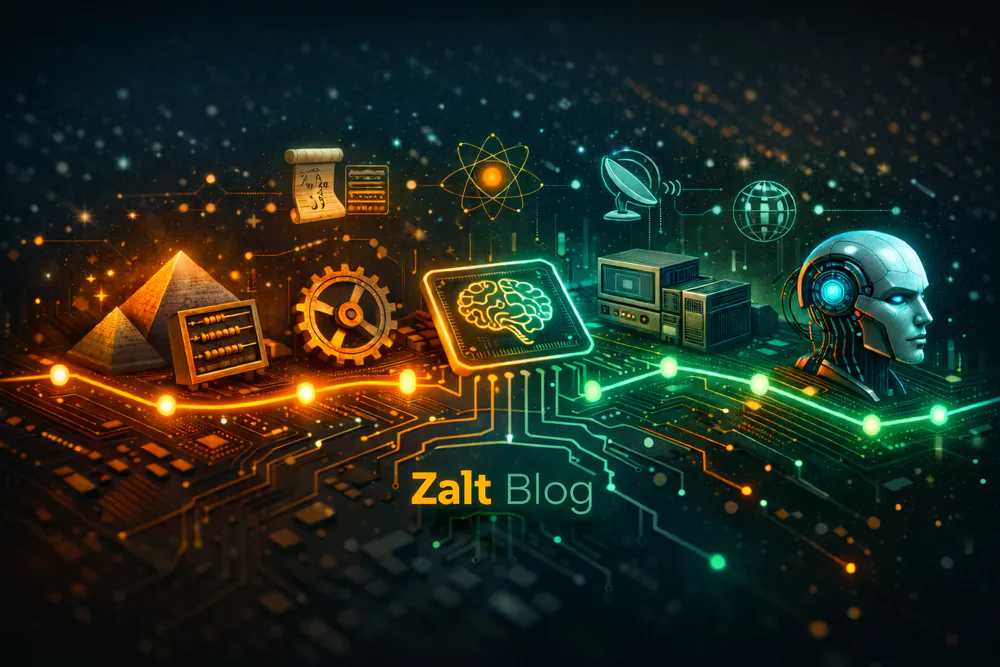
The History of AI in One Timeline
So who invented AI? Maybe we all did. Human survival drove farming → farming needed counting → counting birthed math → math built machines → machines created computers → computers generated data → data trained AI → AI got transformers → transformers power AI. Call it the longest relay race in tech, passed hand-to-hand for thousands of years.

CONSULTING
Ready to build something with AI?
Ready to build something with AI?
From idea to production: custom AI software built on modern architecture with a clear path to launch.
The Vibecoder's Handbook, from idea to production
Everything you need to know about shipping software with AI, from the App idea to production.
What it covers
- 0IntroductionWhat this book is & how to read it
- 1Set UpGet your tools and a running app ready
- 2PlanStructure your idea into a clear specification
- 3ArchitectLay out a modular codebase for your AI
Artificial intelligence didn’t begin with ChatGPT, transformers, or even “AI” as a term. If you want a clean origin point for the field itself, you can start around the mid-20th century: in 1950, Alan Turing reframed the problem by turning “Can machines think?” into something you could actually test. The modern discipline solidified soon after, when researchers started building programs that could reason, learn, and play games.
But none of that work appeared from nowhere. Turing’s question only mattered because centuries of earlier breakthroughs had already assembled the machinery beneath it: logic, mathematics, computation, electricity, communication, and the idea that processes can be formalized and repeated.
That’s the point of this timeline: to show that AI is not one invention, but a long relay race. If you follow the chain far enough back, you eventually reach the first moment humans began treating reality as something measurable: counting, dividing, recording, predicting. Ancient Egyptians counting crops, measuring land, and tracking seasons weren’t “building AI,” but they were building the earliest layer of what makes AI possible: abstraction, measurement, and the habit of turning the world into numbers.
From that foundation came mathematics; from mathematics came mechanisms; from mechanisms came computers; and once computers began producing and storing data at scale, learning systems became inevitable. This timeline traces that progression step by step, so the modern AI boom reads less like a miracle and more like the latest chapter in a story that started thousands of years ago.
Scroll through all entries chronologically or filter by domain to trace a single thread: Mechanics, Mathematics, Physics, Electricity, Computing, Communication, Internet, Mobile, AI. Each discovery builds the foundation for what follows. This isn't just a history lesson, it's a map of how human curiosity became digital reality. Watch how each discovery unlocked the next, creating the building blocks of modern intelligence. But which discovery was the real turning point? The answer might surprise you.
Egyptians Planted The First Number
by Ancient Egyptians
None of it would exist without the need to eat! Around 5,000 years ago, in the process of securing a sustainable food source, ancient Egyptians began searching for ways to count crops, divide harvests, measure fields, and track the seasons.
Survival pushed humans to create order, and from that order came mathematics, the first true language of logic. Every algorithm, computer, and AI model today is built on its timeless foundation.
Egyptians Planted The First Number
by Ancient Egyptians
None of it would exist without the need to eat! Around 5,000 years ago, in the process of securing a sustainable food source, ancient Egyptians began searching for ways to count crops, divide harvests, measure fields, and track the seasons.
Survival pushed humans to create order, and from that order came mathematics, the first true language of logic. Every algorithm, computer, and AI model today is built on its timeless foundation.
Babylonians Found The Missing Numbers
by Ancient Babylonians
Thales Discovered The Spark
by Thales of Miletus
Thales Discovered The Spark
by Thales of Miletus
Pythagoras Measures the Invisible
by Pythagoras
Euclid Writes the First Algorithm
by Euclid of Alexandria
Euclid Writes the First Algorithm
by Euclid of Alexandria
The Greeks Build the First Machine Mind
by Ancient Greek Engineers
Hipparchus Maps the Heavens in Numbers
by Hipparchus
Hipparchus Maps the Heavens in Numbers
by Hipparchus
Gears Create the First Machine Logic
by Ancient Greek Engineers
Al-Khwarizmi Teaches Logic to Count
by Muhammad ibn Musa al-Khwarizmi
Al-Khwarizmi Teaches Logic to Count
by Muhammad ibn Musa al-Khwarizmi
Clockwork Brings Time to Life
by Medieval Monks
Cardano and the Birth of the Impossible Number
by Gerolamo Cardano
Cardano and the Birth of the Impossible Number
by Gerolamo Cardano
Gilbert Gives Electricity Its Name
by William Gilbert
Napier Turns Numbers into Motion
by John Napier
Napier Turns Numbers into Motion
by John Napier
Schickard Builds the Clock That Counts
by Wilhelm Schickard
Pascal Makes the Machine Useful
by Blaise Pascal
Pascal Makes the Machine Useful
by Blaise Pascal
Pascal Discovers the Mathematics of Probability
by Blaise Pascal & Pierre de Fermat
Through letters between them, probability was born, the mathematics of uncertainty. For the first time, randomness had rules, and risk could be reasoned with.
Centuries later, that same logic guides machines that learn from data, weighing odds and outcomes with cold precision. What began as a game of chance became the language of prediction that fuels modern AI.
Newton Invents the Mathematics of Motion
by Isaac Newton & Gottfried Leibniz
Their answer was calculus, a language for change. It could capture acceleration, curve, and flow, turning motion into mathematics. Suddenly, the universe could be traced by numbers.
That insight became the silent engine of optimization. Every AI model trained, every function minimized, every gradient followed, still whispers the logic they discovered: that learning is just change, measured precisely.
Newton Invents the Mathematics of Motion
by Isaac Newton & Gottfried Leibniz
Their answer was calculus, a language for change. It could capture acceleration, curve, and flow, turning motion into mathematics. Suddenly, the universe could be traced by numbers.
That insight became the silent engine of optimization. Every AI model trained, every function minimized, every gradient followed, still whispers the logic they discovered: that learning is just change, measured precisely.
Leibniz and the Dream of Complete Calculation
by Gottfried Leibniz
Leibniz Discovers the Language of Machines
by Gottfried Leibniz
Leibniz Discovers the Language of Machines
by Gottfried Leibniz
Newton's Laws Define the Rules of Motion
by Isaac Newton
Euler Draws the First Map of Connection
by Leonhard Euler
Euler Draws the First Map of Connection
by Leonhard Euler
Franklin Brings Lightning to Earth
by Benjamin Franklin
Electricity Becomes Usable
by Alessandro Volta
He stacked copper and zinc with brine-soaked cloth, and the voltaic pile was born: the first battery, a device that stored potential and released it as current. For the first time, energy could be summoned, not waited for.
That invention lit the age of circuits. Every modern processor, every AI running on portable power, still traces its pulse back to Volta's quiet tower of discs.
Electricity Becomes Usable
by Alessandro Volta
He stacked copper and zinc with brine-soaked cloth, and the voltaic pile was born: the first battery, a device that stored potential and released it as current. For the first time, energy could be summoned, not waited for.
That invention lit the age of circuits. Every modern processor, every AI running on portable power, still traces its pulse back to Volta's quiet tower of discs.
Gauss Computes the Orbit of Ceres
by Carl Friedrich Gauss
Legendre Publishes the Method of Least Squares
by Adrien-Marie Legendre
Legendre Publishes the Method of Least Squares
by Adrien-Marie Legendre
Ampère Finds the Invisible Thread
by André-Marie Ampère
Ohm Teaches Electricity to Speak in Ratios
by Georg Ohm
Ohm Teaches Electricity to Speak in Ratios
by Georg Ohm
Faraday Spins Motion into Light
by Michael Faraday & Joseph Henry
Babbage Dreams of a Thinking Machine
by Charles Babbage
Babbage Dreams of a Thinking Machine
by Charles Babbage
Morse Sends Thought Through Wire
by Samuel Morse & Alfred Vail
Morse code was born: the first digital language, built from two states, on and off. Distance folded; silence began to carry meaning.
That binary pulse became the heartbeat of every future network, from telegraphs to the internet, to the electric whispers between AI systems today.
Light Learns to Follow Its Path
by Daniel Colladon & Jacques Babinet
This was pure physics, the fundamental principle that light could be trapped and directed through transparent materials. It seemed like a curiosity, but it contained the seed of something revolutionary.
That discovery became the foundation of fiber optics. Every fiber optic cable today still relies on the same principle Colladon and Babinet first observed, light following its own reflection, trapped in glass.
Light Learns to Follow Its Path
by Daniel Colladon & Jacques Babinet
This was pure physics, the fundamental principle that light could be trapped and directed through transparent materials. It seemed like a curiosity, but it contained the seed of something revolutionary.
That discovery became the foundation of fiber optics. Every fiber optic cable today still relies on the same principle Colladon and Babinet first observed, light following its own reflection, trapped in glass.
Hamilton Maps the Space of Thought
by William Rowan Hamilton
With that, linear algebra took shape, a system for manipulating vectors, rotations, and multidimensional relationships. Equations could now describe motion, light, and position all at once.
Those same operations power the neural networks of today. Every rotation in 3D graphics, every transformation in AI models, still follows Hamilton's marks on that bridge.
Cauchy: Gradient Descent
by Augustin-Louis Cauchy
Cauchy: Gradient Descent
by Augustin-Louis Cauchy
Boole Turns Logic Into Algebra
by George Boole
His equations didn't describe nature; they described decision. Circuits of thought, long before electricity found them.
That quiet abstraction became the binary heartbeat of every computer. Each flicker of 1 and 0 today is Boole's language, still whispering logic through the wires.
Cayley Teaches Numbers to Work in Teams
by Arthur Cayley
Cayley Teaches Numbers to Work in Teams
by Arthur Cayley
Leclanché Makes Power Portable
by Georges Leclanché
Light Joins the Equation
by James Clerk Maxwell
Light Joins the Equation
by James Clerk Maxwell
Fingers Find Their Home
by Christopher Sholes
Cantor Organizes the Infinite
by Georg Cantor
Cantor Organizes the Infinite
by Georg Cantor
The Human Voice Travels
by Alexander Graham Bell
Edison Turns Light into Industry
by Thomas Edison
Edison Turns Light into Industry
by Thomas Edison
Waves Leave the Wires
by Heinrich Hertz
Tesla Sends Power Across the Horizon
by Nikola Tesla
Tesla Sends Power Across the Horizon
by Nikola Tesla
Data Finds Its Voice in Holes
by Herman Hollerith
Marconi Teaches the Air to Speak
by Guglielmo Marconi, John Ambrose Fleming & Lee De Forest
Marconi Teaches the Air to Speak
by Guglielmo Marconi, John Ambrose Fleming & Lee De Forest
Braun Paints with Electrons
by Karl Ferdinand Braun
Planck Discovers the Quantum World
by Max Planck
Planck Discovers the Quantum World
by Max Planck
Marconi Crosses the Ocean with a Signal
by Guglielmo Marconi
Einstein Explains the Photoelectric Effect
by Albert Einstein
Einstein Explains the Photoelectric Effect
by Albert Einstein
Glass Bottles That Think
by Lee De Forest
Church Writes the Logic of Thought
by Alonzo Church
Church Writes the Logic of Thought
by Alonzo Church
Turing Builds a Mind from Rules
by Alan Turing
His Turing Machine was simple: a strip of symbols, a set of instructions, and a head that moved back and forth, reading and writing. Yet within it lay the entire architecture of modern thought.
Every program, every CPU, every AI simulation still walks the same line, data, rule, result, the mechanical poetry Turing first wrote in his mind.
War Teaches the Air to Speak
by Various (Britain H2S, U.S. SCR-584)
War Teaches the Air to Speak
by Various (Britain H2S, U.S. SCR-584)
Turing Breaks the Unbreakable Code
by Alan Turing
McCulloch Imagines the Electric Brain
by Warren McCulloch & Walter Pitts
Their artificial neuron could perform logic, learn patterns, and combine to form complex behavior. The mind, it seemed, could be computed.
That spark became the first neuron of artificial intelligence. Every neural network today, every AI vision, voice, and thought, still echoes the binary rhythm they discovered: signal, silence, understanding.
McCulloch Imagines the Electric Brain
by Warren McCulloch & Walter Pitts
Their artificial neuron could perform logic, learn patterns, and combine to form complex behavior. The mind, it seemed, could be computed.
That spark became the first neuron of artificial intelligence. Every neural network today, every AI vision, voice, and thought, still echoes the binary rhythm they discovered: signal, silence, understanding.
Von Neumann Draws the Map of the Machine
by John von Neumann
The Transistor Shrinks the World
by John Bardeen, Walter Brattain & William Shockley
Their transistor was small, cool, and precise, a spark of control in crystalline germanium. For the first time, electronic devices could be made tiny, efficient, and reliable.
That discovery became the seed of the digital age. Every chip, every neural processor, every whisper of artificial thought still runs through the transistor's tiny pulse, billions of them smaller than a virus, all descendants of that first fingertip-sized switch.
The Transistor Shrinks the World
by John Bardeen, Walter Brattain & William Shockley
Their transistor was small, cool, and precise, a spark of control in crystalline germanium. For the first time, electronic devices could be made tiny, efficient, and reliable.
That discovery became the seed of the digital age. Every chip, every neural processor, every whisper of artificial thought still runs through the transistor's tiny pulse, billions of them smaller than a virus, all descendants of that first fingertip-sized switch.
Cells That Connect the World
by Douglas H. Ring & W. Rae Young (Bell Labs)
Shannon Builds a Mouse That Remembers
by Claude Shannon
Shannon Builds a Mouse That Remembers
by Claude Shannon
Turing Asks the Unaskable
by Alan Turing
His proposal, the Turing Test, turned speculation into science. Intelligence, he suggested, might simply be behavior convincing enough to pass for mind.
That question still lingers beneath every algorithm. Whether large language model or simple chatbot, all still echo Turing's quiet dare: convince me you understand.
Computing Finds Its Market
by UNIVAC (Eckert-Mauchly Computer Corporation)
Computing Finds Its Market
by UNIVAC (Eckert-Mauchly Computer Corporation)
A Machine Teaches Itself
by Arthur Samuel
CNC Machines Bring Digital Control
by MIT Engineers
CNC Machines Bring Digital Control
by MIT Engineers
Devol Creates the First Programmable Robot
by George Devol
The First Program That Could Reason
by Allen Newell & Herbert Simon
The First Program That Could Reason
by Allen Newell & Herbert Simon
AI Gets Its Name
by John McCarthy & Dartmouth Conference
They believed reasoning could be coded, learning could be taught, and creativity could emerge from logic. In six weeks, a field was born.
From that meeting flowed decades of progress and failure alike. But the name endured. Every breakthrough and setback since has carried the same hope first spoken in that New Hampshire room.
IBM Teaches Memory to Spin
by IBM
IBM Teaches Memory to Spin
by IBM
Rosenblatt Teaches Machines to See
by Frank Rosenblatt
It was crude, slow, and limited, but alive with potential. For the first time, a machine didn't just follow instructions; it improved through experience.
That spark became the soul of modern AI. Every deep learning model today, no matter how vast, still follows Rosenblatt's simple lesson: learn by seeing.
Backus Gives Code a Common Tongue
by IBM (John Backus)
Backus Gives Code a Common Tongue
by IBM (John Backus)
Kilby and Noyce Pack the World Into Silicon
by Jack Kilby & Robert Noyce
Maiman Creates the First Laser
by Theodore Maiman
Maiman Creates the First Laser
by Theodore Maiman
Robots Join the Assembly Line
by George Devol & Joseph Engelberger
Breaking Messages Into Pieces
by Leonard Kleinrock
Breaking Messages Into Pieces
by Leonard Kleinrock
Machines Learn to Talk Over Distance
by Bell Labs
Dreaming of a Galactic Network
by J.C.R. Licklider
Dreaming of a Galactic Network
by J.C.R. Licklider
Words That Link to Other Words
by Ted Nelson
The Mouse Gives Computers a Hand
by Douglas Engelbart
The Mouse Gives Computers a Hand
by Douglas Engelbart
Machines Become Experts
by Edward Feigenbaum & Joshua Lederberg
Weizenbaum Gives Computers a Voice
by Joseph Weizenbaum
Weizenbaum Gives Computers a Voice
by Joseph Weizenbaum
Heilmeier Makes Light Portable
by George Heilmeier
The Network Breathes Its First Word
by UCLA & Stanford (ARPANET)
The Network Breathes Its First Word
by UCLA & Stanford (ARPANET)
A Robot Learns to Think and Move
by Stanford Research Institute
Intel Teaches Memory to Think Fast
by Intel
Intel Teaches Memory to Think Fast
by Intel
Light Becomes the Messenger
by Corning (Robert Maurer, Donald Keck, Peter Schultz)
Messages Begin to Fly
by Ray Tomlinson
Messages Begin to Fly
by Ray Tomlinson
Touch Becomes Reliable
by Dr. Sam Hurst
The Computer Shrinks to a Single Chip
by Federico Faggin & Ted Hoff (Intel)
The Computer Shrinks to a Single Chip
by Federico Faggin & Ted Hoff (Intel)
Ritchie Builds a Language for the Machine Age
by Dennis Ritchie
AI Learns to Diagnose Disease
by Edward Shortliffe at Stanford
AI Learns to Diagnose Disease
by Edward Shortliffe at Stanford
Logic Becomes a Language
by Alain Colmerauer & Robert Kowalski
Satellites Learn the Shape of the Earth
by U.S. Department of Defense
Satellites Learn the Shape of the Earth
by U.S. Department of Defense
Computers Learn to Talk to Each Other
by Bob Metcalfe (Xerox PARC)
The Phone Becomes Portable
by Martin Cooper (Motorola)
The Phone Becomes Portable
by Martin Cooper (Motorola)
Software Finds Its Voice
by Microsoft (Bill Gates & Paul Allen)
Berkeley Opens the Code
by University of California, Berkeley
Berkeley Opens the Code
by University of California, Berkeley
The Personal Computer Finds Its Shape
by IBM
Machines Begin to Feel Motion
by Various (MEMS pioneers)
Machines Begin to Feel Motion
by Various (MEMS pioneers)
Networks That Remember
by John Hopfield
The World Speaks a Common Digital Language
by ARPANET Researchers
On January 1st, 1983, the Internet was born in silence, data flowing freely between once-isolated systems.
That standard became the grammar of the digital world. Every email, every AI query, every packet of thought online still travels in the syntax TCP/IP wrote.
The World Speaks a Common Digital Language
by ARPANET Researchers
On January 1st, 1983, the Internet was born in silence, data flowing freely between once-isolated systems.
That standard became the grammar of the digital world. Every email, every AI query, every packet of thought online still travels in the syntax TCP/IP wrote.
The Internet Gets a Phone Book
by Paul Mockapetris & Jon Postel
A Phone Cuts Its Cord
by Motorola
A Phone Cuts Its Cord
by Motorola
Teaching Machines Common Sense
by Douglas Lenat
Computers Learn to See Us
by Apple (Steve Jobs)
Computers Learn to See Us
by Apple (Steve Jobs)
Windows Opens the World
by Microsoft (Bill Gates)
The Processor That Powers Every Pocket
by Acorn Computers (Sophie Wilson & Steve Furber)
The Processor That Powers Every Pocket
by Acorn Computers (Sophie Wilson & Steve Furber)
Backpropagation Teaches Machines to Learn
by David Rumelhart, Geoffrey Hinton & Ronald Williams
Their answer was backpropagation, a process where each layer taught the one before it what it had done wrong. It wasn't just correction, it was reflection turned into math, letting machines learn from failure for the first time.
That quiet breakthrough reshaped intelligence itself. Every deep model today, every vision, voice, and language AI, still learns by following its own trail of mistakes, just as they once taught it to.
Teaching Machines to Reason with Uncertainty
by Judea Pearl
Teaching Machines to Reason with Uncertainty
by Judea Pearl
The WWW Data Collection Begins
by Tim Berners-Lee
He built the World Wide Web, three quiet inventions, HTTP, HTML, and the URL, woven together to connect thought across machines and continents. What began as a way to share research papers became humanity's largest library, accumulating billions of pages of text, images, and knowledge.
Decades later, that vast ocean of human expression became the fuel for artificial intelligence. Every language model, every chatbot, every AI that understands context learned by reading the Web. Without Berners-Lee's invention, modern AI would have no voice.
The Web Finds Its Window
by Tim Berners-Lee
The Web Finds Its Window
by Tim Berners-Lee
Networks Learn to See Patterns
by Yann LeCun
Lithium Gives Energy a Memory
by Sony (Akira Yoshino)
Lithium Gives Energy a Memory
by Sony (Akira Yoshino)
A Global Dial Tone
by European Telecommunications Standards Institute
A Text as Small as a Thought
by Neil Papworth
A Text as Small as a Thought
by Neil Papworth
A Machine Learns to Play by Playing
by Gerald Tesauro
The Web Gets a Face
by Marc Andreessen & NCSA Team
The Web Gets a Face
by Marc Andreessen & NCSA Team
Sound Learns to Flow
by RealNetworks
Trust Arrives in the Digital World
by Netscape (Taher Elgamal & team)
Trust Arrives in the Digital World
by Netscape (Taher Elgamal & team)
One Cable to Connect Them All
by Intel, Microsoft, IBM & others
Wi-Fi Frees the Web
by IEEE (802.11 Working Group)
Wi-Fi Frees the Web
by IEEE (802.11 Working Group)
AI Defeats Human in Chess
by IBM Deep Blue Team
Networks Learn to Remember
by Sepp Hochreiter & Jürgen Schmidhuber
Networks Learn to Remember
by Sepp Hochreiter & Jürgen Schmidhuber
The Web Finds Its Compass
by Google (Larry Page & Sergey Brin)
Parallel Minds Are Born
by NVIDIA
Originally built for graphics, its architecture proved universal, perfect for teaching neural networks and modeling thought itself.
That chip began a quiet convergence: from pixels to perception, from rendering to reasoning. The GPU had given machines their own kind of parallel mind.
Parallel Minds Are Born
by NVIDIA
Originally built for graphics, its architecture proved universal, perfect for teaching neural networks and modeling thought itself.
That chip began a quiet convergence: from pixels to perception, from rendering to reasoning. The GPU had given machines their own kind of parallel mind.
Mobile Internet Arrives
by NTT DoCoMo
The Cloud Lifts Computing Off the Ground
by Amazon Web Services
Amazon Web Services launched quietly, offering storage and servers to anyone with an Internet connection. Power, once bound to hardware, became rentable like water or light.
That shift built the modern web's invisible scaffolding. Every startup and AI model running today still stands on those rented clouds.
The Cloud Lifts Computing Off the Ground
by Amazon Web Services
Amazon Web Services launched quietly, offering storage and servers to anyone with an Internet connection. Power, once bound to hardware, became rentable like water or light.
That shift built the modern web's invisible scaffolding. Every startup and AI model running today still stands on those rented clouds.
The iPhone Redefines the Handheld World
by Apple (Steve Jobs)
The Birth of Big Data for AI
by Fei-Fei Li (Princeton, then Stanford)
She assembled ImageNet, over 14 million annotated images spanning 20,000 categories. It wasn't just data; it was a curriculum for artificial eyes, organized and labeled with care.
That dataset ignited the deep learning revolution. Without ImageNet, there would be no AlexNet breakthrough, no modern computer vision. Every AI that recognizes faces, reads signs, or navigates the world learned to see by studying Li's patient library of human-labeled reality.
The Birth of Big Data for AI
by Fei-Fei Li (Princeton, then Stanford)
She assembled ImageNet, over 14 million annotated images spanning 20,000 categories. It wasn't just data; it was a curriculum for artificial eyes, organized and labeled with care.
That dataset ignited the deep learning revolution. Without ImageNet, there would be no AlexNet breakthrough, no modern computer vision. Every AI that recognizes faces, reads signs, or navigates the world learned to see by studying Li's patient library of human-labeled reality.
Android Opens the Gates
by Google
AI Wins at Jeopardy
by IBM Watson Team
AI Wins at Jeopardy
by IBM Watson Team
Intelligence Fits in Your Pocket
by Apple (Scott Forstall, Tom Gruber)
Deep Learning Breaks Through
by Alex Krizhevsky, Ilya Sutskever & Geoffrey Hinton
His AlexNet saw patterns humans couldn't articulate. It recognized cats, cars, and flowers with an accuracy that stunned researchers. The breakthrough wasn't a new idea, it was the proof that depth, data, and power had finally aligned.
That moment reignited the field. Deep learning went from curiosity to revolution overnight, reshaping vision, speech, and language. The winter had ended.
Deep Learning Breaks Through
by Alex Krizhevsky, Ilya Sutskever & Geoffrey Hinton
His AlexNet saw patterns humans couldn't articulate. It recognized cats, cars, and flowers with an accuracy that stunned researchers. The breakthrough wasn't a new idea, it was the proof that depth, data, and power had finally aligned.
That moment reignited the field. Deep learning went from curiosity to revolution overnight, reshaping vision, speech, and language. The winter had ended.
Words Became Vectors
by Google (Tomas Mikolov)
Words with similar meanings clustered together. Relationships became directions: king - man + woman = queen. Language had geometry, meaning wasn't symbolic, it was spatial.
That transformation became the foundation of modern language AI. Every model that understands context, from search engines to chatbots, still begins by learning that words are not just symbols, they're locations in the landscape of meaning.
Machines Learn to Imagine
by Ian Goodfellow
Machines Learn to Imagine
by Ian Goodfellow
AI Masters the Infinite Game
by DeepMind (Demis Hassabis, David Silver)
It didn't win through brute force. It learned by watching millions of human games, then taught itself by playing against its own evolving mind. In one move, it played something no human would consider, and it was brilliant.
That victory wasn't just about games. It proved AI could handle complexity beyond calculation, find creativity in chaos, and learn not by following rules, but by discovering them.
Attention Is All You Need
by Google
They called their paper 'Attention Is All You Need,' and for once, it was true.
That design became the foundation of language AI. Every chatbot, translator, and digital poet since speaks through the logic of attention.
Attention Is All You Need
by Google
They called their paper 'Attention Is All You Need,' and for once, it was true.
That design became the foundation of language AI. Every chatbot, translator, and digital poet since speaks through the logic of attention.
Machines Master Strategy Without Human Data
by DeepMind (AlphaZero)
GPT-1 Enters the Conversation
by OpenAI
GPT-1 Enters the Conversation
by OpenAI
AI Learns to Understand Images and Text Together
by Google (BERT, multimodal pretraining foundations)
AI That Teaches Itself From Scratch
by DeepMind (MuZero)
AI That Teaches Itself From Scratch
by DeepMind (MuZero)
AI Solves Biology's Grand Challenge
by DeepMind (John Jumper, Demis Hassabis)
The Birth of Diffusion Models
by UC Berkeley & OpenAI (Ho, Salimans, Sohl-Dickstein)
The Birth of Diffusion Models
by UC Berkeley & OpenAI (Ho, Salimans, Sohl-Dickstein)
Machines Learn to Dream in Pictures
by OpenAI
GPT Blowing People's Minds
by OpenAI (Sam Altman)
It wasn't perfect, it made mistakes, hallucinated facts, and had no true understanding, but it felt different. For the first time, AI wasn't a tool you commanded. It was something you conversed with.
That shift changed everything. From classrooms to boardrooms, people began to wonder: if machines can talk like this, what else becomes possible? The age of conversational intelligence had begun.
GPT Blowing People's Minds
by OpenAI (Sam Altman)
It wasn't perfect, it made mistakes, hallucinated facts, and had no true understanding, but it felt different. For the first time, AI wasn't a tool you commanded. It was something you conversed with.
That shift changed everything. From classrooms to boardrooms, people began to wonder: if machines can talk like this, what else becomes possible? The age of conversational intelligence had begun.
Open Source AI For Everyone
by Meta (Facebook)
Intention is All You Need!
by Mahmoud Zalt at Sista AI
No installs and no tutorials. You speak naturally and the work begins, a return to the way humans have always communicated. Sista AI holds a simple vision of the computer as one living piece of software you can talk to and it does what you want. To reach that vision, the first step was a light voice interface that sits on top of the apps and sites you already use so they can listen and act without being rebuilt.
As this layer spreads, the software fades and only intention remains. You speak and the work happens. When a task appears, a small app forms for that moment, finds the answer, reads it back in a conversational way, then dissolves. The path is a long one, from numbers to logic to circuits to computers to the internet to AI, and it runs back to Egypt where mathematics first took root. Now the human asks and the tool rises to meet the question.
Intention is All You Need!
by Mahmoud Zalt at Sista AI
No installs and no tutorials. You speak naturally and the work begins, a return to the way humans have always communicated. Sista AI holds a simple vision of the computer as one living piece of software you can talk to and it does what you want. To reach that vision, the first step was a light voice interface that sits on top of the apps and sites you already use so they can listen and act without being rebuilt.
As this layer spreads, the software fades and only intention remains. You speak and the work happens. When a task appears, a small app forms for that moment, finds the answer, reads it back in a conversational way, then dissolves. The path is a long one, from numbers to logic to circuits to computers to the internet to AI, and it runs back to Egypt where mathematics first took root. Now the human asks and the tool rises to meet the question.
Thanks for reading! I hope this was useful. If you have questions or thoughts, feel free to reach out.
Content Creation Process: This article was developed using AI writing tools under my direct supervision. I provided the core topic direction and technical expertise, reviewing every section for accuracy. While AI assisted with research, structuring, and initial drafting, I performed substantial manual editing to ensure the final content strictly reflects my judgment and voice.
About the Author
I’m Zalt, a technologist with 16+ years of experience, passionate about designing and building AI systems that move us closer to a world where machines handle everything and humans reclaim wonder.
Let's connect if you're working on interesting AI projects, looking for technical advice or want to discuss anything.
Support this content
Stay in touch
An occasional note when I build or write something new. Leave anytime.
Read More
My take on what's new in AI and programming.
Hire AI Employees
Hire AI Employees that work 24/7. No code.Are you a solo founder still doing sales, marketing, and support by hand? Hire AI Employees to run it all for you. They work 24/7, set up with no code, and go live in minutes.