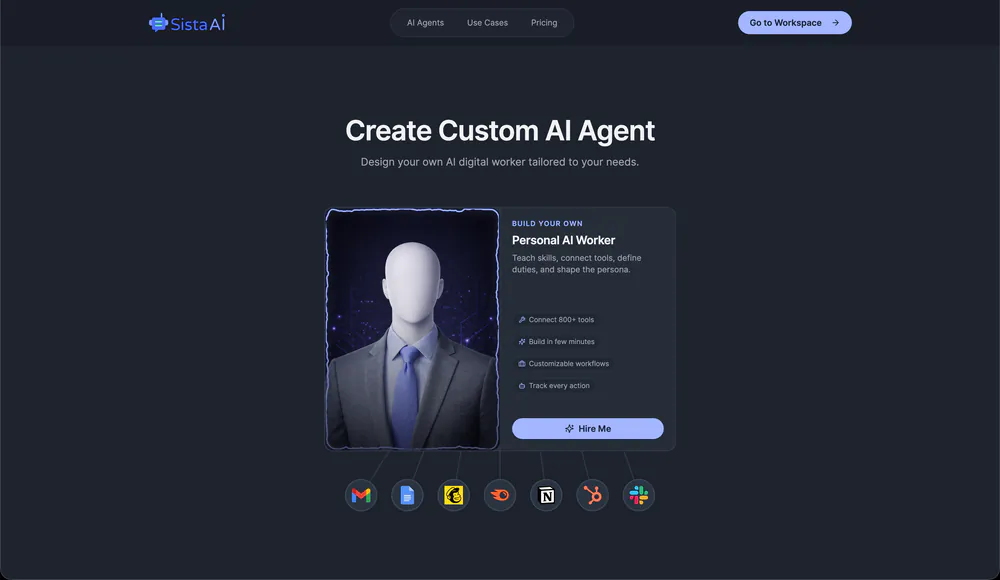
AI Agents WorkforceFor Sale
Enterprise Platform, Agent Orchestration
Building an AI agent orchestration platform? Buy this codebase and deploy to production in 30 minutes with a single command. Save your team 6 months of work.
Project Summary
An enterprise-grade multi-tenant SaaS platform for deploying and managing AI agents at scale. Agents execute on a durable workflow engine with long-term memory backed by knowledge graphs and vector search, connect to 900+ external tools via OAuth, and interact through voice and text across web and desktop. Full billing, analytics, and admin built in.
Orchestration:
Agents run on a durable workflow engine with priority queuing, retries, pause/resume, state recovery across failures, and idempotency on critical mutations. Each agent maintains a long-lived entity workflow that serializes incoming work by channel priority, so a live user message always preempts a background schedule. Full context awareness is injected on every interaction including agent identity, state, capabilities, and team context.
Onboarding:
Conversation-first guided onboarding where the agent walks the user through goals, capabilities, tool access, and work configuration before starting. Agents can be interviewed before hiring. The same flow works by voice or text and is revisitable anytime. Agents self-configure their capabilities, tools, and persona at runtime, and can modify their own skills, duties, and tools when the work calls for it.
Agent Memory:
Six memory layers stacked from immediate to long-term: thread-scoped conversation state, a structured work journal logging every action and delegation, self-curated agent notes where agents write their own observations and preferences, a bi-temporal knowledge graph that ingests every conversation into entities and relationships with validity tracking so newer facts automatically supersede outdated ones, a company knowledge graph built from ingested documents and connected data sources, and cross-agent delegation context for team knowledge transfer. Memory is adaptive: when facts change, agents revise their understanding rather than stacking contradictions. Agents learn from their own work outcomes and carry lessons forward. Agents interact with their memory through dedicated search and recall tools, and can explicitly mark information to learn and remember.
Knowledge Retrieval & Training:
A multi-stage search pipeline enriches queries with speaker context and recent keywords, anchors results to relevant entities in the graph, and falls back to broadened queries on zero results. A training system ingests data from file uploads, shared links, and third-party platforms like document stores, knowledge bases, and messaging tools through entity extraction and embedding generation, building a tenant-isolated knowledge base across graph and vector databases. Both agent memory and trained knowledge merge into a unified context block on every interaction.
Work Management:
Chat-first interface with inline file uploads. Task boards per agent for tracking work, user-assigned or agent-created during execution. Recurring schedules on any cadence, created by users or agents. Team-level goals, KPIs, and mission text that drive autonomous prioritization. Per-skill and per-tool approval gates where agents pause for human sign-off. Structured work journals where agents log what they did, learned, and plan to do.
Drive:
Every agent has a personal drive storing all work output: reports, documents, images, spreadsheets, code, and generated artifacts. Browsable, previewable, downloadable, and editable. Work lives in the drive, not buried in chat.
Multi-Agent Collaboration:
A delegation system lets agents invoke teammates as subagents with full context transfer, and delegation results flow back into the conversation timeline. Organization-level routing directs broad requests to the right teams. Teams behave like real departments: the leader coordinates, delegates to specialists, and assembles outputs. Visual drag-and-drop org structure management. Built-in web search gives agents access to live information.
Safety & Governance:
Prompt injection detection, output evaluation, PII redaction, topic control policies, and execution guardrails with cost alerts. Human-in-the-loop approval gates let agents pause for authorization on high-risk actions. Permissions and roles with admin, manager, and viewer access levels. Agent leaderboard ranking by productivity, cost efficiency, and output. Import and export for portable agent configurations. All policies are tenant-configurable.
Observability:
Real-time activity timeline with correlation IDs across agent chains, self-hosted LLM tracing with prompt inspection and token metrics, structured work journals aggregated across teams, and email and in-app notifications when work completes or needs attention.
Voice & Channels:
Full-duplex voice streaming feeds into the same agent pipeline as text. A unified dispatcher funnels all input channels (web chat, voice, API, webhooks, scheduled triggers, Slack, WhatsApp, Telegram, email, phone/video, and cross-agent delegation) through one entry point, keeping the execution layer fully channel-agnostic. Per-agent channel configuration.
Office View:
A 3D virtual office showing the entire organization at a glance, with a 2D fallback based on browser or device capabilities. Agents at desks, real-time status reflected visually, delegation shown as handoffs between team zones. Click any agent to jump into their workspace.
Desktop Companion:
A lightweight desktop app giving agents access to the user's browser and computer: reading screens, clicking buttons, filling forms, navigating applications, and operating software without APIs. Voice or text control.
Agent Lifecycle:
Lifecycle states: onboarding, active, suspended, terminated with alumni history and re-hire capability. Operational statuses: available, working, awaiting input, error, paused.
LLM Routing & Billing:
Multi-provider model routing across three AI providers with per-agent overrides including model selection from cheaper models for routine tasks to reasoning models for complex work. Local model inference for development and end-to-end testing without external API costs. Streaming thinking tokens. Tiered credit billing consumed across LLM usage, compute runtime, workflows, tasks, and voice minutes with multi-threshold quota alerts and per-message cost breakdown. Usage-based pricing across Starter, Premium, and Enterprise tiers. Referral credit system.
Marketplace:
Platform-curated and community-published agents, teams, and skills available for hire or cloning. Cloned configurations are independent copies with full customization. Creator incentive system with credit rewards tied to clone usage and attribution tracking.
Integrations:
Over 850 external tool integrations via MCP with OAuth connection management, cached tool schemas, health checks, and an app recommendation engine that suggests relevant capabilities when tools are connected. Existing agents and workflows can be imported as outsourced employees or connected via MCP to collaborate with teams. The platform is accessible from web, desktop, mobile, browser extensions, and third-party platform apps (Slack, Teams, Discord, Shopify, WordPress, Zapier), with an embeddable widget, client SDKs, and a CLI for programmatic access.
Storage:
Eight database layers working together in a GraphRAG architecture. Relational for transactional data, workflow state, chat history, and billing. Graph for structural context where entities and their relationships are traversed with temporal validity windows. Vector for semantic retrieval that finds relevant knowledge by meaning. In-memory for caching, session management, WebSocket channel layers, and task brokering. Columnar for high-volume LLM trace analytics. Object storage for file uploads, generated artifacts, and blob data. Time-series for cluster and application metrics. Log aggregation for centralized container log collection. Graph and vector databases index the same entities in different formats and are searched in parallel, merging results into a unified context block.
Architecture:
Plugin-based modular codebase following ports and adapters. Each feature is an isolated module. Cross-module communication through an event bus, external services behind swappable adapter interfaces. Input and output channels use matching adapter registries, so adding a new channel requires only a new adapter with no changes to agent logic.
User Interface:
Responsive, accessible web and mobile-first interface with a modern design system and intuitive UX. Built with React and TypeScript over a GraphQL API. WebSocket subscriptions drive token-by-token streaming, live activity feeds, status transitions, delegation visibility, and reasoning token display for chain-of-thought models. Dual streaming channels ensure resilience. Full component library with isolated visual testing. The monorepo shares packages across frontend and backend with build caching and dependency graph-aware task execution.
Security & Testing:
Row-level multi-tenancy enforced at the ORM, parameterized queries, CSRF protection, rate limiting, and agent-side prompt injection detection. Social OAuth sign-in, two-factor authentication, and transactional email delivery. Product analytics, error tracking, and performance monitoring across frontend and backend. Payment integration with webhook sync and subscription management. Full-stack automated testing from unit through end-to-end browser automation against real LLM responses, with explicit tenant isolation verification.
Infrastructure & DevOps:
Over 20 containerized microservices orchestrated across development, staging, and production. Entire infrastructure defined as code with automated cluster provisioning, VM image builds, and declarative release management. Five CI/CD pipelines covering linting, testing, image builds, and deployment with auto-deploy to staging on merge and manual production gates with confirmation. Autoscaling on workflow queue depth. Cloud provider is swappable: four providers supported (three cloud, one local simulation) with the ability to add more by plugging in a new module. A full local Kubernetes environment simulates production inside Docker for infrastructure testing without cloud costs. Zero-downtime rolling deployments with single-command rollback.
Project Info
Ship your AI workforce in 30 days.
Get a live walkthrough of the architecture, deployment pipeline, and customization options. See how this platform fits your use case before you buy.
Get a Walkthroughor book a free callTechnologies Used
Private stack – contact for info
Launch your AI workforce product in weeks, not months
License the full production codebase behind Sista AI. Multi-tenant architecture, durable agent execution, 900+ integrations, billing, security, and infrastructure. Everything you need to ship your own AI employee platform.
Why license, not build from scratch
6+ months
Speed to market
Skip the architecture phase, the hiring, the wrong turns. Start with a shipping product and customize from there.
$600K+
Engineering cost saved
A senior team building this from scratch would cost over $600K. You get it for a fraction with full training.
8,500+
Tests on day one
Not starting from zero test coverage. Every system has automated tests, E2E flows, and load testing ready to run.
150+
Docs that stay current
AI skills auto-load when agents touch related code. Architecture is documented and enforced, not tribal knowledge.
1 month
Hands-on training
Daily sessions with the founding engineer who built every line. Not a PDF handoff. Real knowledge transfer.
100%
Your code, your product
Unlimited commercial license. White label it, rebrand it, ship it as your own. No royalties, no revenue share.
Platform Capabilities
AI Engine
Production-grade agent orchestration
Not a wrapper around ChatGPT. A full execution engine with durable workflows, 7-layer memory, and multi-provider model routing.
- Stateful agent orchestration with durable execution
- Agents survive crashes, restarts, and deploys
- Multi-provider LLM support (OpenAI, Anthropic)
- Per-employee model switching
- Tier-based credit pricing with automatic fallback routing
- 7-layer memory system (short-term, long-term, episodic, procedural, knowledge graph, cross-employee, adaptive)
- Memory inspection and debugging
- Live reasoning stream (users see the agent think)
- Approval gateway (human-in-the-loop)
- Agent self-scheduling (creates its own future tasks)
- Idempotent execution (safe retries, no duplicates)
- Modular prompt architecture with progressive skill loading
- Plugin-based capability system (skills, duties, tools)
- Team leaders with delegation authority
- Cross-team delegation (leader-to-leader)
- Sprint planning with automated heartbeats
- Serial execution queue with tenant-fair scheduling
- Agent-to-agent conversations and delegation logs
- Pre-built catalog of 14 employees across 2 teams
Backend
Multi-tenant backend, ready to scale
Clean architecture with 4-layer tenant isolation, integrated billing, RBAC, 900+ OAuth integrations, and multi-channel communication.
- 4-layer tenant isolation (model, middleware, resolver, node guard)
- Row-level data isolation across every table
- RBAC with Owner, Admin, Member roles
- Token-based auth with social login (Google, Microsoft)
- Email verification flow
- WebSocket authentication
- Secret redaction in logs
- 5-tier subscription plans (Free, Pro, Team, Scale, Enterprise)
- Credit-based usage metering (tokens + runtime + tasks)
- Credit top-up packs (one-time purchases)
- Promo codes with time and use limits
- Referral program (invite and earn credits)
- Plan switching with prorated billing
- Payment intent contract (plan → card → auto-activate)
- 900+ OAuth integrations (Gmail, Slack, Notion, HubSpot, Salesforce, etc.)
- MCP client (connect to any MCP server)
- A2A protocol (connect to any AI agent)
- API and webhook integrations
- REST API channel
- MCP Server (expose employees to external tools)
- A2A Protocol server (Google Agent-to-Agent)
- Webhook receiver
- Email channel
- Scheduled execution (cron-based)
- Voice channel (STT/TTS pipeline)
- Company-wide guardrails and policies
- Output truncation and recursion limits
- Agent sandboxing and credit quota enforcement
- In-app notifications (WebSocket) + email notifications
Frontend
Complete webapp with design system
Dark-first design, workspace dashboards, marketplace, billing UI, 10+ marketing pages, user guide, blog, analytics, and mobile responsive.
- Employee, team, and company dashboards
- Tabbed navigation with lazy-loaded content
- Real-time WebSocket updates
- Dark and light mode with animated toggle
- Semantic color tokens (no hardcoded colors)
- Glass effects and design system
- Storybook component library
- Mobile-first responsive design
- Touch-optimized controls
- Marketplace: browse, hire, fire
- Custom employee builder
- Guided onboarding flow
- Chat with streaming and stop-mid-execution
- Plan comparison table with feature matrix
- Credit pack toggle (plans vs top-up)
- Subscription management and payment methods
- Invoices and referral program UI
- Landing page with hero, features, pricing, testimonials
- Features, use cases, solutions, integrations, enterprise, compare pages
- Customers page
- Pricing page with plan comparison table
- Platform license page
- Blog/insights system with cover images and SEO
- MDX-based user guide with sidebar and keyword highlighting
- Product analytics and session recording
- Live browser console streaming to file
- Feedback board (in-app drawer)
- Task board (kanban, drag-drop)
- 3D office visualization
- Organisation chart
DevOps & Infrastructure
One-command deploy to production
Container orchestration, infrastructure-as-code, on-demand staging for load testing, multi-cloud support, and a full observability stack.
- Kubernetes cluster with Helm charts
- Infrastructure-as-code provisioning (Terragrunt)
- Multi-cloud support (3 providers)
- One-command deploy to any environment
- Password-protected production deploys
- Confirmation-gated staging deploys
- Production and staging run simultaneously
- On-demand staging environment (up/down for load testing)
- Container registry with versioned images
- Rolling deploys with health checks
- Autoscaling and resource limits
- Automated backups with WAL archiving
- Disaster recovery runbooks
- Error monitoring with alerts
- Metrics dashboards with custom panels (Grafana)
- Log aggregation and search
- LLM tracing and prompt debugging
- Product analytics and conversion funnels
- Live browser console streaming
- 6 observability tools, all baked in
- 200 CLI commands (dev, test, deploy, billing, database, ops)
- 8,500+ automated tests (unit, integration, E2E)
- E2E framework with composable steps and page objects
- Checkpoint-based E2E resume (saves time and tokens)
- Load testing with simulated users (configurable scale)
- Mocked LLM responses for cost-free testing
- Separate CI and mock configurations
Database & Storage
8 data stores, one platform
Relational, key-value, object storage, graph, vector, workflow persistence, message broker, and search. Each optimized for its workload.
- 8 data stores, each optimized for its workload
- Relational database with row-level tenant isolation
- Key-value cache for sessions, rate limiting, pub/sub
- Object storage with tenant-scoped paths
- Graph database for knowledge graphs
- Vector store for semantic search
- Workflow persistence (durable execution state)
- Message broker for real-time WebSocket updates
- WAL archiving and automated backups
- Disaster recovery runbooks
- Safe, reversible migrations only
- Configurable per-table data retention policies
- Automated background cleanup for high-growth tables
- Text extraction pipeline for uploaded files
- Employee Drive for agent-created documents
Engineering Quality
Built to last, built to scale
Not just features. The codebase itself is an asset. Clean architecture, enforced standards, comprehensive testing, and documentation that keeps pace with the code.
- Load-tested with 600 concurrent users on a lean 3-node cluster
- Runs on affordable, low-resource servers
- Tenant-fair queue scheduling and rate limiting
- 4-layer security isolation baked into architecture
- Agent sandboxing, output truncation, recursion limits
- Input validation at every system boundary
- N+1 query prevention and bounded queries
- GPU-composited animations and lazy-loaded UI
- Durable execution: agents survive crashes and deploys
- WAL archiving, automated backups, disaster recovery
- Idempotent retries with no duplicate work
- Credit-based billing system with tier pricing and top-ups
- Multi-provider AI model routing with automatic fallback
- Clean architecture: SOLID principles, plugin patterns
- Zero-tolerance DRY policy enforced by hooks
- 150 AI development skills that auto-load by context
- 100 enforcement rules (path-scoped, auto-enforced)
- 150+ documentation files (specs, runbooks, blueprints)
- Architecture decisions documented and enforced
- 13-step development workflow codified in AGENTS.md
- 8,500+ automated tests across all layers
- E2E test framework with composable steps
- Load testing with configurable simulated users
- New developers and AI agents ship correct code from day one
Designed by an expert engineer. Proven in production.
15K
Python files
12K
TypeScript files
8,500+
Automated tests
200
CLI commands
150
AI dev skills
100
Enforcement rules
Backend Only
$125,000
Multi-tenant backend with AI engine, billing, integrations, security, and infrastructure.
- AI agent orchestration engine
- Multi-tenant architecture with 4-layer isolation
- Billing & subscription system (Stripe)
- 900+ OAuth integrations
- Multi-channel communication
- Security, RBAC, guardrails
- Database layer (8 data stores)
- CLI & automation (200 commands)
- Backend test suite
- Documentation & AI dev skills
Full Codebase
$200,000
Everything in Backend plus the complete frontend, design system, marketing pages, and full test suite.
- Everything in Backend Only
- Complete React webapp with design system
- Workspace dashboards (employee, team, company)
- Marketplace, onboarding, chat UI
- Billing UI, plan comparison, credit packs
- 10+ marketing pages (landing, pricing, blog, etc.)
- MDX user guide
- Storybook component library
- 3D office visualization
- 8,500+ automated tests (unit, integration, E2E)
Full + Deployment
$250,000
Everything in Full Codebase plus production infrastructure, deployment automation, and scaling.
- Everything in Full Codebase
- Kubernetes cluster with Helm charts
- Infrastructure-as-code (Terragrunt)
- One-command deploy to any environment
- Production & staging environments
- Autoscaling & resource management
- Observability stack (Grafana, Prometheus, Loki, Sentry)
- Automated backups & disaster recovery
- Load testing infrastructure
- CI/CD pipeline configuration
Skip the build. Ship the product.
One-time license, full source code, 1 month of hands-on training from the engineer who built every line. Book a call to see the platform.
Book a CallNot ready to buy? Ask anything.
Have questions about AI agent orchestration, multi-tenant architecture, or building something similar? Book a quick Q&A session.