AI Workforce PlatformFor Sale
AI, AI Agents Orchestration, Enterprise Platform
Building an AI agent orchestration platform? Buy this codebase and deploy to production in 30 minutes with a single command. Save your team 6 months of work.
Project Summary
An enterprise-grade multi-tenant SaaS platform for deploying and orchestrating AI agents at scale. Agents run on a durable workflow engine with long-term memory backed by a knowledge graph and vector search, plug into thousands of external tools through OAuth, and converse with users by voice and text across web, desktop, and mobile. Billing, analytics, administration, security, and the production infrastructure are fully built in.
Built for AI-assisted maintenance from day one. The core was designed and reviewed against 16+ years of system architecture and code-quality experience, then reinforced with extensive testing, strict linting, typed contracts, and clearly defined skills, rules, and architectural boundaries that bound what any coding agent is allowed to change. The codebase can be extended without ever opening it. Engineers and operators work through a coding agent, and the guardrails keep the agent's output correct, consistent, and safe to ship.
Dive deeper:
Project Info
Ship your AI workforce in 30 days.
Get a live walkthrough of the architecture, deployment pipeline, and customization options. See how this platform fits your use case before you buy.
Get a Walkthroughor book a free callTechnologies Used
Private stack – contact for info
Designed by an expert engineer. Proven in production.
19K
Python files
14K
TypeScript files
17,000+
Automated tests
400
CLI commands
350
AI dev skills
200
Enforcement rules
Top 10 reasons to buy this codebase
$100/month runs 800 concurrent users
No managed services, no $2K/month AWS bills. Self-hosted on affordable servers you fully control. You own the stack, not a cloud vendor.
Agents survive crashes, restarts, and deploys
Durable execution means agent state persists through infrastructure failures. Deploy mid-conversation and the agent picks up exactly where it left off.
Multi-layer tenant isolation, baked into architecture
Multi-tenancy is enforced at the model, middleware, resolver, and node guard layers. Every query, cache key, and file path is tenant-scoped by architecture.
One command deploys to any cloud provider
Not locked to AWS, GCP, or Azure. Fully codified provisioning spins up a complete production cluster on any provider. Destroy and rebuild anytime, everything comes back.
350 AI dev skills auto-load by context
AI coding agents working on the codebase automatically receive architecture knowledge, coding rules, and system context for whatever area they touch. New developers ship correct code from day one.
17,000+ automated tests from day one
Unit, integration, and end-to-end tests across every system. Load testing with simulated users. Mocked LLM responses for cost-free test runs.
Monitoring deploys with the code, not after
50+ alert rules, dashboards, and notification channels are all codified and deploy with the app. Infra, app, and business events (signups, upgrades, billing failures, autoscaling, errors, warnings) push to Telegram in real time. Destroy the cluster, rebuild it, every alert comes back.
LLM provider goes down, users never notice
Multi-provider model routing with automatic failover. If the primary provider is unreachable, the system walks a fallback chain across providers without user intervention.
Credit billing system ready to monetize
Five subscription tiers, credit packs, promo codes, referrals, per-model metering, and Stripe integration. Launch and charge on day one.
Full Growth OS ships with the product
Social media publishing, blog generation, SEO, email sequences, directory listings, community engagement, and customer follow-up all run as agent tasks on a schedule. Marketing is not a bolt-on. It ships in the box.
Platform Capabilities
The AI Agent
Not a chatbot. A powerful AI agent.
Durable execution, 7-layer memory, multi-provider models, 1,000+ integrations, desktop control, voice, and team delegation. The agent is the product.
Durable execution that survives anything
Agent state persists through crashes, deploys, and restarts. Deploy mid-conversation and the agent picks up exactly where it left off. Safe retries with idempotent execution guarantee no duplicate work.
7-Layer persistent memory
Short-term, long-term, episodic, procedural, knowledge graph, cross-employee, and adaptive memory layers. Backed by a graph database and vector store. Memory inspection and debugging tools included.
Multi-provider LLM with automatic failover
Support for OpenAI, Anthropic, and more. Per-employee model switching from the UI. If the primary provider goes down, a 3-provider fallback chain activates automatically. Users never notice.
Automatic cost-saving model routing
Every message is routed in real time to the right-sized model: light, conversational turns are answered by a fast, inexpensive model while real work keeps the premium one. It decides by semantic, embedding-based intent matching, not brittle keyword rules, so it understands paraphrases and other languages and never downgrades a real task. On everyday back-and-forth this cuts LLM spend substantially with no drop in quality where it counts, ships as a per-workspace toggle, and reports its own savings.
thousands of integrations and developer protocols
OAuth integrations for Gmail, Slack, Notion, HubSpot, Salesforce, and hundreds more. MCP client and server, A2A protocol (Google Agent-to-Agent), REST API, webhooks, and email channels.
Browser automation with your logged-in session
Agents drive your real browser through the companion desktop app. They reuse your existing logged-in sessions, so no credentials are shared and MFA stays intact. Any site you can use, the agent can use: fill forms, navigate dashboards, scrape gated pages, submit workflows, download reports, and read results back into the conversation.
Computer controller that sees your screen and runs commands
Agents see your screen through screenshots, click anywhere, type anywhere, and drive any application: native apps, browsers, terminals, IDEs. They run terminal commands safely with confirmation gates for destructive actions, organize files, open and interact with any installed app, and automate multi-app workflows. All on your local machine, never through a cloud VM.
Voice, chat, and multi-channel
Real-time voice with sentence-level streaming TTS. Live chat with reasoning stream visible. REST API, MCP Server, A2A Protocol, webhooks, email, and scheduled execution. Channel-aware prompting adapts behavior per channel.
Personal mailbox and Slack DM for every agent
Each agent receives its own unique inbound email address. Users and external systems email the agent directly, and replies go out from that same address with full thread history preserved. A per-tenant Slack bot exposes every agent for direct messages and channel mentions, so Slack-native users talk to any specific agent without leaving Slack. Same dispatcher, same memory, same execution layer behind every channel.
Joins live meetings as a participant
Agents attend Google Meet, Zoom, and Microsoft Teams calls as named participants. They transcribe in real time, speak when addressed, take action items, and post a structured summary plus full transcript back to the workspace afterwards. No separate meeting tool, no copy-paste. The meeting is just another channel.
Team hierarchy and delegation
Team leaders delegate to specialists. Cross-team delegation between leaders. Agent-to-agent conversations with full delegation logs. Serial execution queue with tenant-fair scheduling. Circular delegation detection prevents loops.
Skills, duties, and self-management
Plugin-based capability system: skills (what they know), duties (what they always do), tools (what they can use). Modular prompt architecture with progressive skill loading. Agents self-schedule future tasks and run sprint planning.
Human-in-the-loop and guardrails
Approval gateway for sensitive actions. Company-wide policies and content guardrails. Output truncation, recursion limits, and credit quota enforcement. 4-layer anti-loop protection prevents runaway agents.
Live reasoning and interactive feedback
Users see the agent think in real-time. Comment on agent-created images, documents, and tasks with instant agent replies. Pre-built catalog of 28 employees across 4 teams ready to hire.
Train on your own data from any source
Upload files, paste URLs, or connect popular apps (Notion, Google Docs, Drive, Gmail, Slack, Outlook, OneDrive, Confluence). Agents learn from your content. Knowledge inspector lets you query and verify what was indexed.
Pre-hire interview system
Marketplace candidates run interviews using the full agent runtime before being hired. Isolated from workforce lists. Interview transcripts carry over when a candidate is promoted to employee.
The Product
A complete app your customers use on day one.
Workspace dashboards, marketplace, billing, onboarding, admin panel, 10+ marketing pages, user guide, blog, legal hub, and changelog.
Workspace dashboards
Employee, team, and company-level views. Tabbed navigation with lazy-loaded content. Real-time WebSocket updates. Task board with kanban drag-and-drop, work journal, and file drive.
Marketplace and onboarding
Browse, interview, and hire from a pre-built catalog. Custom employee builder for bespoke roles. Guided onboarding flow walks new hires through configuration step by step.
Chat with streaming and feedback
Real-time streaming chat with stop-mid-execution. Inline comments on agent deliverables (images, docs, tasks) with instant agent replies. In-app feedback board for product discovery.
Billing, subscriptions, and credit packs
5-tier plans (Free through Enterprise), credit-based metering (tokens + runtime + tasks), one-time top-up packs, in-app promo codes, Stripe coupon code support (percent/amount discounts, forever/once/repeating durations) applied automatically to subscriptions and renewals, referral program, prorated plan switching, and payment intent contracts. Ready to monetize on day one.
Design system and theming
Dark-first design with animated light/dark toggle. Semantic color tokens, glass effects, Storybook component library. Mobile-first responsive with touch-optimized controls. GPU-composited animations.
10+ marketing pages
Landing page with hero, features, pricing, and testimonials. Features, use cases, solutions, integrations, enterprise, and competitor comparison pages. Customers page. Blog with cover images and SEO.
AI-discoverable public surface
Every public page (landing, features, use cases, solutions, blog, changelog, legal hub, and full user guide) is served as clean machine-readable markdown alongside the rendered HTML, with an llms.txt index, structured metadata, and crawlable JSON feeds. All marketing/catalog content (features, plans, pricing, solutions, integrations, testimonials, platform data) is also exposed via a public read-only REST API so other websites, including your own, can fetch and render it at their build time. AI search engines and external agents can discover, ingest, and cite the product the same way humans browse it. Built for AI-driven distribution, not just traditional SEO.
User guide and help center
MDX-based guide with sidebar navigation and keyword highlighting. Designed for two audiences at once: humans who scan, and AI agents that index it as a structured knowledge base, including both internal coding agents working on the codebase and external agents that need to learn what the platform does.
Super admin dashboard
Internal dashboards for Revenue, User Growth, Credits, Workforce, Cost Analysis, LLM Intelligence, Execution, Promotions, and Email. Full user management: search, inspect, impersonate, suspend, reset, grant credits, adjust plans. Impersonation carries privilege-escalation prevention and full audit trail.
Automated lifecycle and marketing emails
Transactional emails (welcome, trial expiry, payment failure, referral invites) plus intelligent follow-up campaigns that trigger based on user activity, inactivity, and engagement patterns. React-rendered templates with CSS inlining. Per-user rate limiting prevents spam.
Legal and compliance hub
Terms, privacy policy, DPA, AUP, data retention, sub-processor list, cookie consent, and responsible disclosure. Trust center showing compliance status. Public changelog and status page.
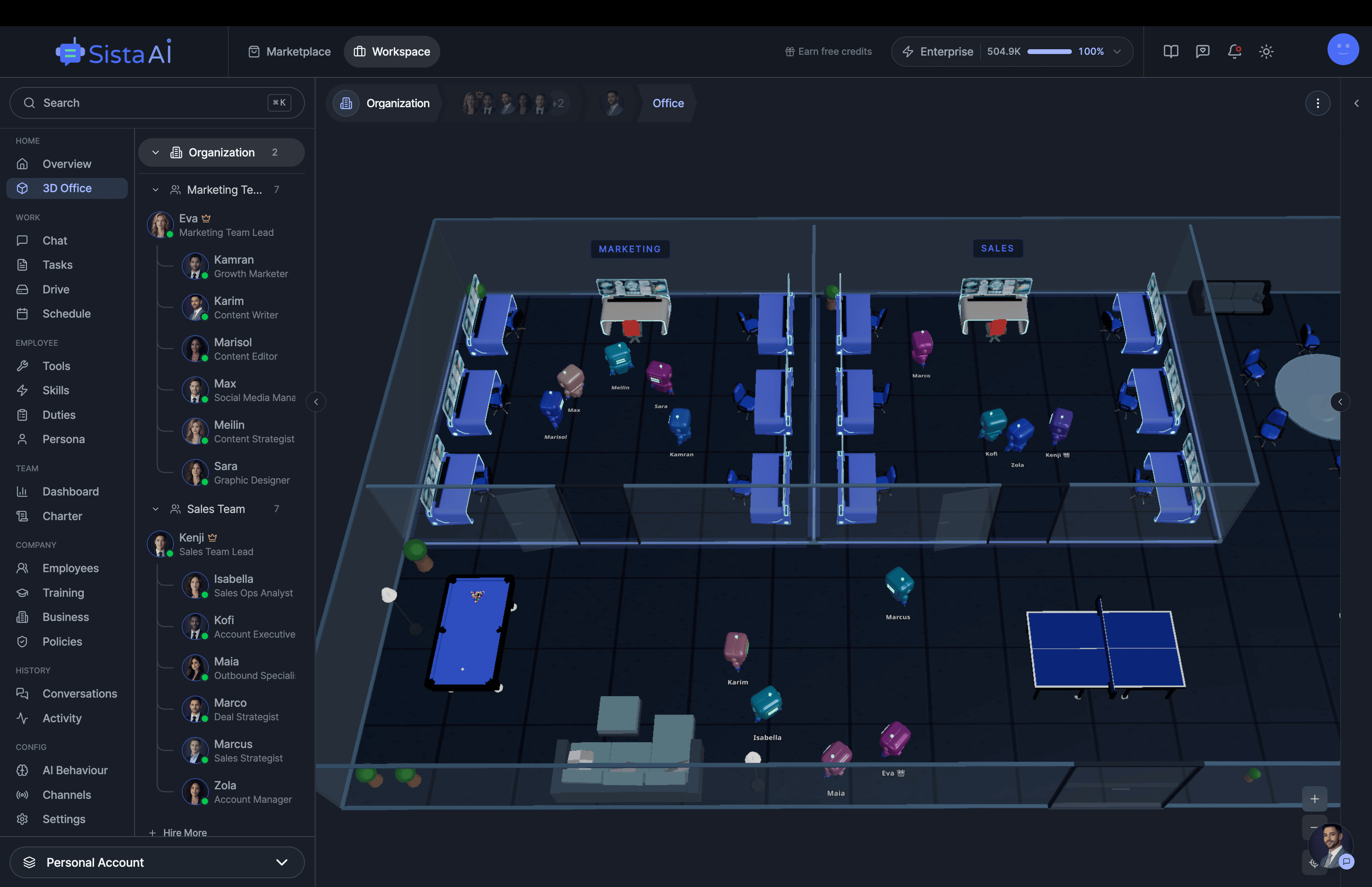
3D office and org chart
3D office visualization showing employee locations and status. Organisation chart with team hierarchy. Both update in real-time as the workforce changes.
Granular plan-based feature gating
Fine-grained per-plan controls over every dimension of the product: how many AI employees a tenant can hire, how many teams they can create, how many members per team, how many knowledge bases, which integrations are active, execution depth limits, and exactly which UI panels and actions are visible. Two delivery styles, tooltip popups that surface upgrade prompts inline, and card wraps that gate entire sections behind a plan wall. Backend enforcement at every mutation boundary. Central config, one line per feature, one place for all limits. Operators adjust the gating model and per-plan quotas without touching application code.
Engagement streaks with milestone rewards
Habit-forming retention layer built in. Tracks consecutive weekday visits, surfaces a flame counter in the header, and grants free-credit milestones at 5, 7, 14, and 30 days. Weekday-only by design (boss gets weekends off). One-time grants per milestone, founder-exclusion built in, feature-flagged so the credit economics can be tuned without redeploying. Plug-in module that reads existing visit data, no new write paths in the request hot path.
Built-in growth engine
A full marketing and growth operation packaged as agent skills and CLI commands. Auto-publishes posts to social media, generates and schedules blog articles with cover images and SEO metadata, sends and sequences promotional emails and follow-up campaigns, manages advertisement copy and creative rotation, and drives search engine optimisation. Every growth action runs as an agent task, produces an activity record in the workspace, and is auditable like any other operation. The growth engine ships as part of the platform, not a bolt-on integration.
Security & Compliance
Enterprise-grade security, built into every layer.
Multi-layer tenant isolation, 2FA, audit logging, GDPR data rights, automated data retention, secret management, and compliance documentation.
Multi-layer tenant isolation
Enforced at model, middleware, resolver, and node guard layers. Every database query, cache key, file path, and workflow ID is tenant-scoped. Row-level data isolation across every table.
Authentication and access control
Token-based auth with social login (Google, Microsoft). Email verification. WebSocket authentication. RBAC with Owner, Admin, and Member roles. Two-factor authentication (TOTP) with configurable token lifetime.
Brute-force and account protection
Account lockout after failed attempts with per-IP and per-username tracking. Cooloff periods with rate limiting. Automatic recovery after timeout.
Comprehensive audit logging
Every login, logout, token refresh, password change, and OAuth event logged with IP address, user ID, and HTTP status. Separate audit logger with no propagation to prevent tampering.
Secret management
Encrypted secrets in git. Decryption key stored outside repo. No real secrets in example files. Automatic log redaction strips API keys, tokens, and PII from every log line before storage.
GDPR data subject rights
Data export, deletion, and portability implemented. Configurable per-table data retention policies with automated background purge. DPA and sub-processor list published.
Content security and CORS
Restrictive CSP headers with prod vs dev modes. Explicit CORS origin allowlist with no wildcards. Admin panel and metrics endpoints blocked from public internet.
Agent safety controls
Prompt injection protection via content wrapping and escaping. Output truncation and recursion limits. Credit quota enforcement before every LLM call. Circular delegation detection prevents agent loops.
Network and container security
Default-deny Kubernetes network policies. Explicit service-to-service rules. Non-root containers. Input validation at every system boundary. Query optimization guards prevent unbounded scans.
Infrastructure
One command to deploy. Any provider. Any time.
Kubernetes, Helm, Terragrunt, multi-cloud portability, autoscaling, 8 data stores, automated backups, disaster recovery, and zero-downtime deploys. All codified.
One-command deploy, any provider
Kubernetes cluster with Helm charts and Terragrunt provisioning. Not locked to any cloud vendor. Portable to any provider. Destroy and rebuild anytime, everything comes back from code.
Production and staging environments
Password-protected production deploys. Confirmation-gated staging deploys. Both run simultaneously. On-demand staging spins up and down for load testing. Pay only for hours used.
Zero-downtime rolling deploys
Container registry with versioned images. Rolling deploys with health checks. Old pods stay alive until new pods pass readiness. Deploy 10+ times a day without user disruption.
Autoscaling on affordable infrastructure
Load-tested with 800 concurrent users on a lean 3-node cluster at $100/month. Horizontal pod autoscaling with resource limits. On-demand burst nodes for traffic spikes.
Backups and disaster recovery
WAL archiving for point-in-time recovery. Automated daily backups with retention policies. Documented disaster recovery runbooks. Safe, reversible migrations only.
8 purpose-built data stores
Relational database, key-value cache, object storage, graph database, vector store, workflow persistence, message broker, and search. Each optimized for its workload. Automated cleanup for high-growth tables.
Database tuned for performance at scale
Connection pooling, read replicas ready, indexes on every hot query path, N+1 guards enforced in code, bounded queries, aiterator-based streaming for large reads, and automated retention for high-growth tables. Query performance is measured, not assumed.
Secure tunnel access to admin surface
Super admin dashboard, Grafana, Prometheus, Temporal UI, and internal ops tools are never exposed to the public internet. Access is gated behind short-lived authenticated tunnels. One command per tool. Zero attack surface for admin panels.
400 CLI commands
Dev, test, deploy, billing, database, and ops commands. Stripe sync, database shell, tunnel to production, load test, E2E test, hot-reload, and more. Everything you type daily as a one-liner.
File management and text extraction
Upload pipeline with text extraction for PDFs, DOCX, and plain text. Tenant-scoped storage paths. Employee Drive for agent-created documents. File management UI in the workspace.
Observability & Monitoring
An owned analytics layer plus every external tool you'd integrate anyway.
An in-house tracking system you fully own, ad-blocker-proof and GDPR-clean, running side-by-side with the industry-standard stack. Real-time alerting, metrics dashboards, log aggregation, LLM tracing, error tracking, Real User Monitoring (RUM), product analytics, and browser console streaming. All provisioned as code.
Owned in-house tracking layer
Server-side activity feed, daily visit roll-ups, funnel beacon, and credit-grant audit trail all live in your own database, never in a third-party tool. Ad-blockers, notrack cookies, and privacy extensions cannot hide them. Every meaningful action by every user, employee, and tenant is queryable from your admin panel without a vendor login. Use it as the source of truth, ship the rest to PostHog and friends as a convenience layer.
Full cost traceability: credits for users, dollars for operators
Every agent action produces a structured activity record that captures the complete cost lineage. Users see credits consumed, a unified abstraction that covers LLM tokens, embedding calls, voice processing, tool API charges, and compute runtime. Operators see the same activity in the super admin broken down by dollar value per provider and source. Every execution is queryable: what it did, how long it ran, which models it hit, how much it cost the user in credits, and how much it cost the business in real money, across every provider simultaneously. Nothing is estimated. Every dollar is traced to its activity.
Real-time Telegram alerts for everything that matters
50+ pre-configured alert rules deployed as code. Infrastructure events (crash loops, CPU/memory spikes, disk pressure, autoscaling scale-ups, node failures, pod restarts, certificate expiry). Application events (errors, warnings, failed jobs, slow queries, LLM provider outages). Business events (new signups, plan upgrades, plan downgrades, new payment methods, billing failures). Every alert comes back intact after a cluster rebuild because rules live in code, not a UI. One bot, one chat, full situational awareness on your phone.
1,000+ Prometheus metrics
Custom Grafana dashboards for every subsystem. Infrastructure metrics (CPU, memory, disk), application metrics (latency, queue depth, error rates), and business metrics (active users, credits burned, LLM costs).
Centralized log aggregation
Every log line from every service collected, indexed, and searchable. Full-text search with structured filtering. Query production logs without SSH. Configurable retention policies.
LLM tracing and prompt debugging
Every AI call traced with model, tokens, latency, cost, and conversation context. View the exact assembled prompt for any execution. Debug agent behavior down to the individual LLM call.
Error tracking with instant alerts
Exception capture with full stack traces, breadcrumbs, and user context. Instant push notifications on new errors. Grouped by root cause. Source maps for frontend errors.
Real User Monitoring (RUM)
Web app performance, errors, and usage tracking. Frustration signals (rage clicks, dead clicks, error clicks). Deployment tracking shows impact of each release. User demographics and session replay.
Product analytics and conversion funnels
Event tracking across the full user journey: signup, onboarding, first hire, first chat, credit purchase, plan upgrade. Session recording shows exactly what users see. Feature adoption dashboards.
Product intelligence from first visit to renewal
The platform connects acquisition, onboarding, activity, satisfaction, adoption, subscription movement, refunds, and operating cost into one evidence trail. An operator can see what brings customers in, what they do next, where they stall, and whether the business result improves.
Quality, conversation, and system health
Built in evaluation reviews AI output against defined standards. Conversation monitoring turns direct feedback and unresolved follow ups into an improvement signal. System Health makes blocked approvals, delivery, limits, connections, and work hygiene visible before they become customer problems.
Controlled delivery with recorded decisions
Feature access can be controlled by eligibility and staged rollout. Each test keeps the assigned audience, what they actually received, product behavior, commercial outcome, and reliability guardrails together. The operator can widen, pause, or end a change with an accountable decision record.
Browser console streaming
Frontend console.log, console.error, and console.warn streamed live to central logs. Debug user-reported issues without asking them what they saw. Same query interface as backend logs.
One secure operating control room
Six views keep the operator oriented: executive operations; finance and commercial health; growth and customer intelligence; platform operations; reliability and safety; and product and tool adoption. Each view keeps the underlying evidence available, so operational decisions do not depend on spreadsheet exports or direct database access.
Sensitive data scanning
Automatic detection and redaction of API keys, tokens, and PII in logs. Runs on every log line before storage. No secrets in observability data.
The Engineering
The codebase itself is the asset.
Clean architecture, 17,000+ tests, 350 AI dev skills, 200 enforcement rules, 150+ documentation files, and a developer experience designed for AI-assisted development.
Clean architecture, enforced by tooling
SOLID principles, plugin patterns, zero-tolerance DRY policy enforced by pre-commit hooks. Dependency direction enforced (schema to service to model to adapter, never up). Code quality is a gate, not a guideline.
350 AI development skills
Context-aware knowledge files that auto-load when AI agents touch related code. Architecture decisions, data flows, key files, and gotchas for every subsystem. The right context reaches the agent automatically.
200 enforcement rules
Path-scoped rules that activate when relevant files are modified. Security, billing, infrastructure, naming, and testing rules. Not documentation you read once. Rules the tooling enforces on every change.
150+ living documentation files
Specs, runbooks, blueprints, and architecture decisions. Updated in the same commit as the code change. If a doc is stale, the tooling flags it. Documentation that keeps pace with the codebase.
17,000+ automated tests
Unit, integration, smoke, load, stress, and end-to-end tests across every system. E2E framework with composable steps, page objects, and checkpoint-based resume. Comprehensive billing and security test suites. Pre-launch manual QA checklist with 30 sections covering every feature. Security testing pipeline includes penetration testing, vulnerability scanning (SAST/DAST), dependency and CVE scanning, secret scanning, container image scanning, OWASP Top 10 coverage, and third-party security audits.
Load testing with mocked LLM
Simulated concurrent users at configurable scale. Mocked LLM responses so load tests cost nothing in API fees. Separate CI and mock configurations. Load test reports with performance analysis.
13-step development workflow
Codified in AGENTS.md: read task, read docs, understand code, design, self-critique, revise, implement, E2E test, existing tests, new tests, user review, update docs, commit. Every AI agent follows the same workflow.
Developer experience designed for AI
AI agents and human developers use the same workflow, same skills, same rules. The codebase is structured so any AI coding tool produces correct code without special training. The architecture teaches the agent.
Intent-based frontend routing
Every public and in-app surface declares a typed intent, what the visitor is trying to accomplish. The routing layer reads that intent and selects the matching journey: onboarding, upgrade, demo request, outreach, direct action, or a custom path. Users land at the next right step for them rather than a generic homepage. New journeys register in a central intent config without touching page code. Every route decision is traceable and can be handed to an agent as context.
Latest versions of every core framework
Django, Python, React, and TypeScript tracked to their latest stable releases. Dependencies auto-audited on every build. No legacy versions, no deprecated APIs, no security debt inherited on day one.
Optimized end-to-end for scale, performance, and security
Every layer tuned: backend query performance, frontend bundle size, connection pooling, cache hit rates, container image size, network policies, security headers. Not a rough draft made fast later. Built to ship.
50+ scheduled AI agents that maintain the platform around the clock
More than 50 AI agents run on a continuous schedule against the live system. Some investigate errors, synthesise findings into action plans, and dispatch sub-agents to ship fixes and close gaps. Others analyse user traffic patterns, usage behaviour, and product engagement, building per-user profiles, detecting adoption trends, and surfacing insights the product team would otherwise miss. They have full read access to logs, metrics, traces, errors, and product analytics, and write access to the codebase. The platform debugs, profiles, and enhances itself while you sleep.
The Business OS
You are not buying software. You are buying a running business.
A full growth, marketing, and operations layer ships alongside the product. Social media, content, customer engagement, financial intelligence, automated reporting, and transparent releases. One operator can run it all.
Growth Operating System
A full marketing machine packaged as agent skills and CLI commands. Auto-publishes to social media, generates blog articles with SEO metadata and cover images, schedules promotional emails, manages ad copy rotation, and syndicates content to directories and partner sites automatically. Every action produces an auditable activity record in the workspace.
Community and customer engagement
Agents monitor communities, respond to relevant threads, follow up with users based on their activity, handle inbound inquiries, and run multi-step email sequences. Customer outreach, win-back campaigns, and interview requests all execute automatically against defined schedules and triggers.
Automated changelog and transparent releases
Every code change made by an agent or a developer is logged and structured. A scheduled agent compiles completed work into versioned release notes and publishes them to the public changelog automatically. Users see what shipped. Nothing gets buried.
Full financial intelligence per user, per service, per provider
Every agent action is broken down by real dollar cost: which model was called, how many tokens were consumed, what the runtime cost, what the user paid in credits, and what the business retained as margin. Costs are queryable by tenant, by employee, by tool, and by provider. No estimates. Every dollar traced to its source.
Automated weekly and daily business reports
Scheduled agents pull from logs, metrics, analytics, and the database to generate structured reports delivered to the operator automatically. Revenue, signups, activation rates, churn signals, LLM costs, and infrastructure spend. Delivered on schedule without anyone asking for them.
Token usage and cost planning with budget ceilings
Configurable budget ceilings per tenant, per agent, and per execution. Usage is metered, tracked, and surfaced in the super admin before it becomes a surprise. Operators set the ceiling. The system enforces it.
Single-operator design
Every operational function has a corresponding agent or CLI command. Deploy, monitor, respond to users, publish content, ship fixes, and review analytics without a team. One person with a terminal and a chat interface can run the full business.
Multi-platform content distribution
Articles, changelogs, and product updates publish across the main site, partner blogs, AI indexing directories, and the personal portfolio automatically. Content surfaces wherever buyers look, without manual reposting.
Platform self-improves around the clock
More than 50 AI agents run on a continuous schedule. They investigate errors, synthesise findings into action plans, dispatch sub-agents to ship fixes, analyse user behaviour, and surface product insights. Full read access to logs, metrics, traces, and analytics. Write access to the codebase. The platform debugs and enhances itself while you sleep.
AI-run sprint planning and product backlog
Agents hold sprint planning sessions, break down objectives into tasks, prioritise the backlog, assign work, track completion, and write the sprint review. Product development runs on a schedule without a project manager. The operator stays in control at the top while the agents handle the execution layer.
Launch your AI workforce product in weeks, not months
License the full production codebase behind Sistava. Multi-tenant architecture, durable agent execution, thousands of integrations, billing, security, and infrastructure. Everything you need to ship your own AI employee platform.
Why license, not build from scratch
6+ months
Speed to market
Skip the architecture phase, the hiring, the wrong turns. Start with a shipping product and customize from there.
$600K+
Engineering cost saved
A senior team building this from scratch would cost over $600K. You get it for a fraction with full training.
17,000+
Tests on day one
Not starting from zero test coverage. Every system has automated tests, E2E flows, and load testing ready to run.
350
Docs that stay current
AI skills auto-load when agents touch related code. Architecture is documented and enforced, not tribal knowledge.
1 month
Hands-on training
Daily sessions with the founding engineer who built every line. Not a PDF handoff. Real knowledge transfer.
100%
Your code, your product
Unlimited commercial license. White label it, rebrand it, ship it as your own. No royalties, no revenue share.
Skip the build. Ship the product.
One-time license, full source code, 1 month of hands-on training from the engineer who built every line. Book a call to see the platform.
Book a CallBackend System
API + AI Engine
$299,000
The production engine your AI product runs on. Years of backend work, already done. Plug in your features and ship.
- Multi-tenant AI runtime
- Durable execution + orchestration
- Billing, credits, and subscriptions
- thousands of integrations + data ingestion
- Chat, voice, email, and messaging channels
- Auth, RBAC, and tenant isolation
- 8 workload-specific data stores
- 400 CLI + ops commands
- Backend test suite
- Docs + 350 AI dev skills
Full-Stack Application
Backend + Frontend
$399,000
Everything in Backend plus the full customer-facing product: app, dashboards, marketplace, onboarding, admin, docs, and marketing surface.
- Everything in Backend System
- Full React web app
- Streaming chat + live reasoning UI
- Company, team, and employee dashboards
- Marketplace, interviews, and onboarding
- Desktop companion app
- Super admin dashboard
- 100+ marketing pages + blog + legal hub
- 3D office + real-time org chart
- Design system, guide, and 17,000+ tests
Full-Stack + DevOps
Production Infrastructure
$499,000
Everything in Full-Stack Application plus the production infrastructure to deploy, observe, scale, and recover the platform yourself.
- Everything in Full-Stack Application
- Kubernetes + Helm + Terragrunt
- Auto-scalable + Portable infra-as-code
- Production + staging environments
- Zero-downtime rolling releases
- Autoscaling + worker scaling
- Grafana and Prometheus
- Backups + disaster recovery
- Secure tunnels for admin tooling
- Load testing + CI/CD
Latest Articles
Programming insights and more.
Not ready to yet? Ask anything.
Have questions about AI agent orchestration, multi-tenant architecture, or building something similar? Book a quick Q&A session.