


What Can AI Agents Actually Do?
AI agents can take responsibility for defined business work, not only answer a prompt. With a clear role, useful context, approved tools, and sensible boundaries, an AI agent can research information, create documents, prepare follow ups, update systems, coordinate with other AI agents, and bring people the decisions that need human judgment.
The important shift is simple. Instead of managing every step through a string of prompts, you give an outcome to an AI employee and let it plan, execute, check its work, and continue within the boundaries you set.
I am Mahmoud Zalt, and through Sistava I build AI employees around this exact idea. The goal is not another chatbot. It is a digital worker that helps turn a business goal into finished work.
AI Agents Can Own Work, Not Just Answer Prompts
Most people still use AI in a loop. You ask for a task, get an output, decide the next step, then ask again. That is useful for one off work, but it still leaves you managing the process.
An AI agent works differently when it has a responsibility to own. You define the role, responsibilities, goal, context, and access it needs. Then you define what a good result looks like. The flow becomes: you set a responsibility and outcome, the AI employee plans, executes, checks, continues when appropriate, and returns a result or an exception that needs you.
That does not mean the AI is making every important decision. It means you stop spending your attention on the repeatable steps around those decisions. You stay responsible for direction, priorities, and sensitive calls. The employee handles the preparation and follow through.
AI Agents Can Use Tools to Get Work Done
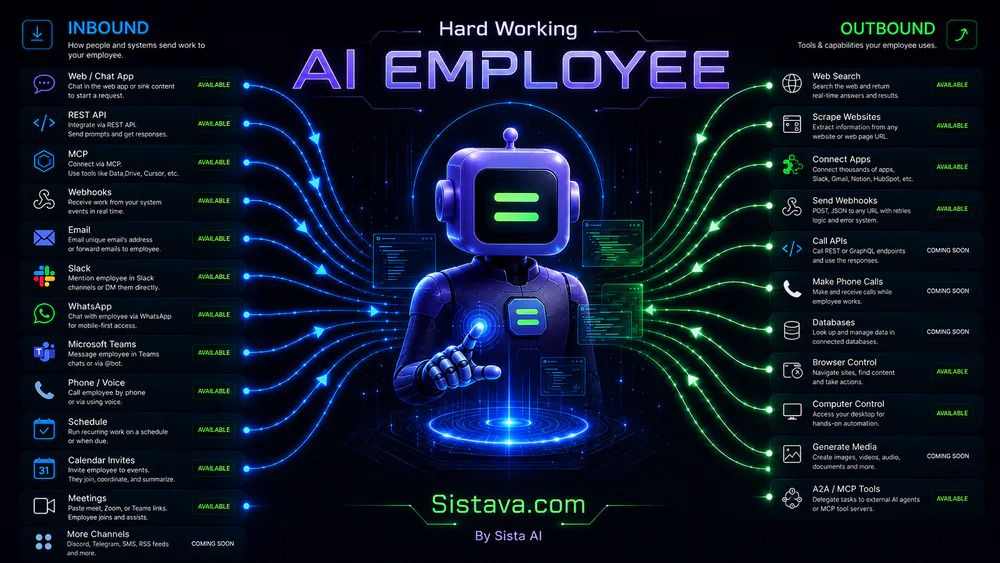
An AI agent becomes useful to a business when it can work where the business already works. Depending on its role and the permissions you provide, it can search and research the web, browse websites, read and create documents, prepare emails, work across business apps, use APIs and webhooks, analyze information, create content and media, and move information between systems.
Having many tools is not the interesting part. The useful part is knowing which tool to use, when to use it, and why. A good AI employee does not open every app. It takes the next useful action toward the outcome it owns.
Permissions should match the responsibility. A research employee may only need read access and a place to write its findings. An operations employee may need permission to update a project board. A customer facing workflow may need an approval point before any message is delivered. Clear boundaries make useful autonomy possible.
AI Agents Can Keep Work Moving on a Schedule
This is where AI agents become much more valuable. They can own recurring responsibilities and respond to events you define, so important work does not depend on someone remembering to write the next prompt.
- Prepare a report every morning.
- Review the sales pipeline every Monday.
- Check for new opportunities throughout the day.
- Turn meeting decisions into follow up tasks.
- React to a defined event and take the next approved action.
You decide what the employee owns, what it can do without asking, what requires review, and where updates should go. The employee works within those rules. The result is continuity. Work keeps moving while you focus on the decisions that need your attention.
The best place to start is one repeating responsibility with a visible result. A daily brief, a weekly pipeline review, or meeting follow through is a better first assignment than asking an AI agent to run the whole business.
AI Agents Can Work Together as a Team
One AI employee is useful. A team of specialized employees can handle a connected process. One employee can research an opportunity. Another can analyze it. Another can create the material. Another can prepare outreach and track the follow up.
The value is not only division of work. It is shared context. Each employee can receive the findings and task details it needs for the next step, instead of restarting from a blank chat. Responsibilities can be visible, blockers can be clear, and decisions can be escalated to the right person.
That starts to look less like using a collection of AI tools and more like managing a digital workforce. People remain responsible for the goals and decisions. The AI team takes on more of the operational work that connects those decisions to execution.
AI Agents Should Keep You Informed, Not Make You Supervise
You should not need to sit inside an AI chat all day watching work happen. The employee does the work and sends the important updates where you already communicate, including email, Slack, Microsoft Teams, WhatsApp, meetings, notifications, and the web app.
A useful update is not a long activity feed. It is a completed result, a clear exception, a decision that needs you, or a timely request for input. The aim is to save attention, not to create another system that needs managing.
This is why the quality of the role matters. A well defined AI employee knows what to report, who should receive it, and when to stop and ask. That keeps people in control without making them direct every small step.
How Should a Business Start With AI Agents?
- Choose one repeated responsibility. Pick work that matters and has a clear outcome.
- Give the employee context. Connect the information and approved tools it actually needs.
- Set boundaries. Define the actions it can take, the actions that need approval, and the updates you want.
- Review and improve. Look at the results, tighten the role, then add the next responsibility.
The technology is still early, and no product has solved every part of this perfectly. But the capability is moving quickly. Every real business workflow exposes another limitation, another useful use case, and another improvement worth making.
Frequently Asked Questions
What can an AI agent do for a business?
An AI agent can own defined responsibilities such as research, reporting, document creation, follow ups, system updates, and coordination across approved business tools. It should escalate decisions that need human judgment.
Are AI agents the same as chatbots?
No. A chatbot mainly responds to a prompt. An AI employee has a role, context, goals, and approved tools so it can make progress on a responsibility over time.
Can AI agents work with a team?
Yes. AI employees can divide responsibilities, share useful context, hand work to the next employee, and keep people informed about results and blockers.
What is the best first use for an AI agent?
Start with recurring work that has a clear result, such as a daily report, a pipeline review, meeting follow through, or a research brief.
Try an AI Employee With a Real Responsibility
The real value of an AI agent is not how human it sounds. It is how much useful work it can responsibly own. Give it one clear responsibility, the right context, and sensible boundaries. Then see what changes when work keeps moving without another prompt.